Losing a daughter changes everything. Parents, siblings, and loved ones experience a pain that words struggle to contain. When the time comes to write a message for the funeral, the fear of saying the wrong thing can be paralyzing. Too formal, too distant, too cliché: every phrasing seems inadequate. Some concrete guidelines help find the right tone, one that acknowledges the grief without minimizing it.
What Makes a Condolence Message Sincere After the Loss of a Daughter
A message resonates when it doesn’t try to console at all costs. Saying “I am here” matters more than attempting to explain or make sense of it. Acknowledge the pain without trying to fix it remains the first instinct to adopt.
Have you noticed that clichés sound hollow in these moments? It’s normal. A “she’s in a better place” or “time heals all wounds” can hurt parents who are living the absence in the present. Better a short, genuine sentence than a long, conventional paragraph.
Three elements make a difference in a message intended for parents who have just lost their daughter:
- Addressing the deceased by her first name, which shows that you are speaking to this specific family and not just any bereaved person.
- Recalling a concrete memory or a character trait of the deceased, even briefly, rather than remaining in the abstract.
- Offering specific help (errands, meals, silent presence) instead of the vague “don’t hesitate to reach out if you need anything.”
Choosing comfort messages for a funeral that fit the relationship you had with the family also changes the tone. A close friend can afford an intimate tone. A colleague will maintain a more sober phrasing, without being cold.
Examples of Comfort Messages Based on Your Relationship with the Family
Message from a Close Friend of the Parents
“I think of [first name] and her laughter that lit up every room. I can’t find the words to lighten your pain, but I am here, today and in the weeks to come. I will stop by on Wednesday, unless you prefer to be alone.”
“Your daughter meant a lot to me too. I remember our afternoons at the park when she was little. I’m not asking how you are; I’m simply saying that I’m here for you.”
Message from a Colleague or Acquaintance
“I am deeply saddened by the loss of [first name]. The whole team is thinking of you. If you need us to take over anything at the office, we’re here.”
“Please accept my sincere condolences. I can’t imagine the ordeal you are going through. Take all the time you need; we are here for you.”
Message Addressed to a Grieving Brother or Sister
The support of siblings is often overlooked. The association “Apprivoiser l’Absence” offers support groups dedicated to brothers and sisters, organized in Paris and several regional cities. Acknowledge the role of siblings in the grieving process can start with a simple message.
“I know your sister was much more than just a sister. Your pain matters just as much as your parents’. I am here if you want to talk, or just walk in silence.”
Formulations to Avoid on the Day of a Daughter’s Funeral
Some phrases come from good intentions but produce the opposite effect. Avoid phrases that minimize or rationalize the loss protects the relationship with the bereaved family.
- “I know how you feel”: no one experiences the same grief, and this phrase shuts down dialogue instead of opening it.
- “At least she’s not suffering anymore”: parents don’t need justification for their child’s passing.
- “You are young; you can have other children”: this phrase denies the uniqueness of the deceased and causes lasting pain.
- “You have to be strong”: imposing strength on someone who is collapsing adds guilt to the pain.
Respectful silence, a hand on the shoulder, a look that says “I see your pain” can sometimes mean more than a poorly chosen phrase. A short and honest message touches more than a long, polite text.

What Medium to Choose for Writing Your Condolences
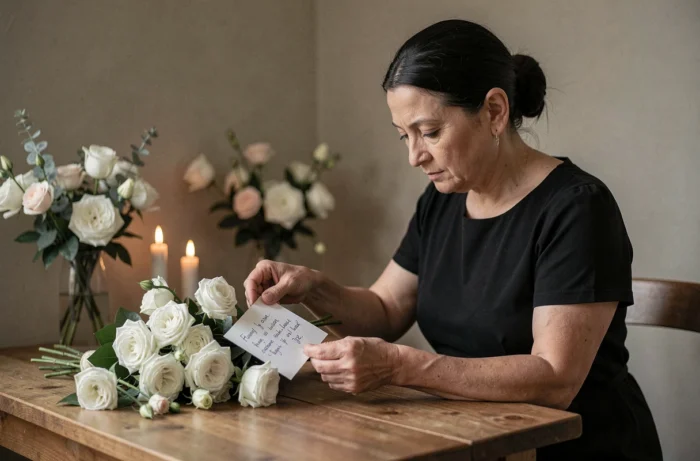
The choice of medium influences how the message is received. A handwritten card slipped into an envelope remains the most personal gesture. Writing by hand slows you down and forces you to weigh each word. Parents may reread it in a few months.
A text message is appropriate when the news is recent and you want to show your immediate presence. Keep it brief: two or three sentences are enough. The tone can be more direct, less formal. A text message shows responsiveness, while a handwritten card shows depth.
For a message read during the ceremony or placed in the condolence book, aim for four to six lines. Start by naming the deceased, add a memory or a quality, then conclude with a concrete expression of support.
After the Funeral: The Follow-Up Message No One Sends
The majority of messages arrive in the days surrounding the funeral. Then silence sets in. The parents’ grief, however, does not follow this timeline. A message sent several weeks after the funeral can have more impact than all the condolences on the day itself.
“I still think of [first name]. How are you, really? I’m not asking you to respond; I just wanted you to know that I haven’t forgotten.”
This type of message asks for nothing. It reminds the family that the world hasn’t turned the page. The isolation that follows the first weeks of mourning is often the most challenging time, when a discreet presence matters the most.
One last note: if a loved one’s suffering seems to prevent any return to daily life for an extended period, suggesting a support group or specialized assistance is not an intrusion. It can sometimes be the most helpful gesture.