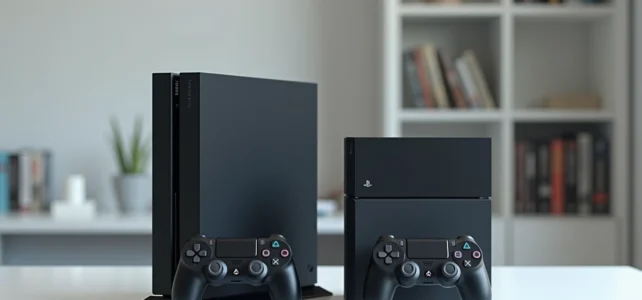
The PS4 fat (original model released at the end of 2013) and the PS4 Slim (launched in September 2016) share the same processor, the same GPU, and run exactly the same games. Comparing these two consoles is therefore about measuring differences based on peripheral criteria: size, noise, power consumption, network connectivity, and long-term reliability. These differences, often underestimated, influence the choice in the second-hand market.
PS4 fat vs PS4 Slim: comparative specifications table
| Criterion | PS4 fat (CUH-1000) | PS4 Slim (CUH-2000) |
|---|---|---|
| Processor | x86-64 AMD Jaguar 8 cores | x86-64 AMD Jaguar 8 cores |
| GPU | AMD Radeon 1.84 TFLOPS | AMD Radeon 1.84 TFLOPS |
| Original storage | 500 GB | 1 TB |
| Dimensions | 27.5 x 5.3 x 30.5 cm | 26.5 x 3.9 x 28.8 cm |
| Weight | 2.8 kg | 2.1 kg |
| Wi-Fi | 2.4 GHz only | 2.4 GHz + 5 GHz |
| Optical port (S/PDIF) | Yes | No |
| Launch price | €349 | €299 |
The CPU and GPU are identical line for line. The differences focus on the physical format, base storage, and wireless connectivity. An article detailing the differences between PS4 fat and slim allows for a deeper exploration of each technical point for undecided buyers.
Noise and power consumption of the PS4: what the field shows
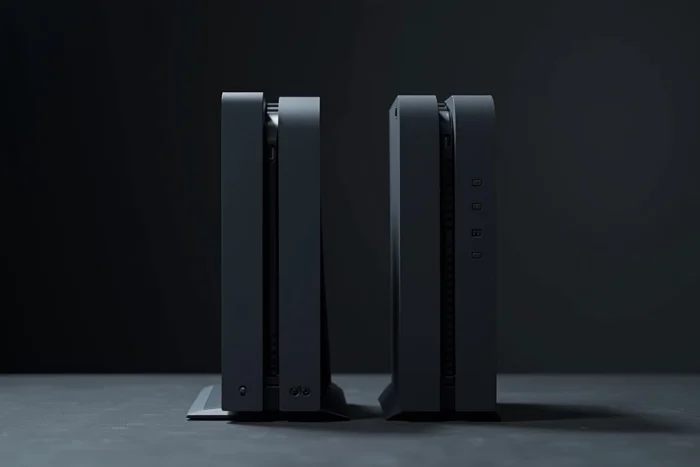
On paper, both consoles display the same computing power. In practice, the Slim stands out due to a redesign of the motherboard and cooling system that significantly reduces fan noise.
The PS4 fat is often described by its users as noisy, even comparable to a “jet fighter” during prolonged sessions on demanding games. The Slim is significantly quieter on a daily basis, and this difference increases with the aging of the thermal paste on the original model.
Power consumption also favors the Slim. Its revised internal architecture generates less heat, which reduces the fan’s workload and lowers the electricity bill over the long term. For daily use of several hours, this criterion is not negligible.
Wi-Fi 5 GHz on PS4 Slim: a tangible network advantage
The PS4 fat is limited to Wi-Fi on the 2.4 GHz band. The Slim supports Wi-Fi 5 GHz, a less congested band in most households.
The difference is especially felt in two situations:
- Downloading large games, where the 5 GHz band offers a more stable and often faster speed in a typical home environment
- Online gaming, where latency can decrease due to fewer interferences with other devices connected to the network
- System and game updates, which are frequent on PS4, benefiting from a more reliable connection without requiring an Ethernet cable
If the console is connected via Ethernet, this point makes no difference. However, for exclusive Wi-Fi use, the Slim has a measurable advantage.
Reliability and maintenance in the second-hand market
In 2026, both models are purchased almost exclusively second-hand or refurbished. The choice is therefore not limited to specifications but to the actual condition of the machine.
The PS4 fat poses more maintenance issues. Its less efficient thermal design accelerates the wear of the thermal paste and puts more strain on the fan. Recent repair guides indicate that overheating remains the primary reason for intervention on this model.
The Slim, due to its more recent design and improved cooling, has a more favorable history of failures. This does not guarantee anything for a specific unit, but the general trend points to a perceived higher reliability.
Some points to check when buying second-hand:
- The noise of the fan when cold and after about ten minutes of gaming (a very loud fan on a fat often signals thermal paste that needs replacing)
- The condition of the Blu-ray drive, which may show signs of wear on the early CUH-1000 models
- The actual capacity of the hard drive (the 500 GB fats fill up quickly with recent games, and a replacement with an SSD is feasible on both models)
The case of the optical S/PDIF port
The PS4 fat has an optical audio output (S/PDIF) that Sony removed on the Slim. For users who have a headset or soundbar connected via optical, this removal can be problematic. Most audio setups now go through HDMI, but the absence of an optical port on the Slim remains a point to anticipate if the audio equipment is older.
PS4 fat or Slim in 2026: which model to prefer
Gaming performance is strictly identical between the two consoles. The framerate, resolution, and compatibility with the PS4 catalog do not vary from one model to another.
The Slim accumulates peripheral advantages: more compact format, double storage in original configuration, quieter ventilation, reduced consumption, and Wi-Fi 5 GHz. The only area where the fat retains an advantage is the presence of the optical audio port.
In the second-hand market, the price difference between the two models remains moderate. A well-inspected Slim purchase offers better protection than a cheaper fat that is more prone to overheating. The extra cost is justified by the peace of mind in daily use, especially if the console is expected to serve for several more years.