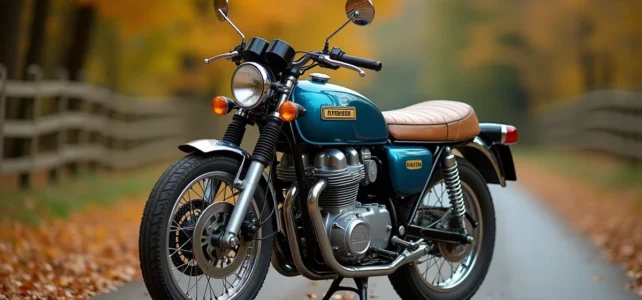
The Suzuki GT 750, produced between 1972 and 1977, remains one of the few water-cooled two-stroke three-cylinder engines ever mass-produced on a motorcycle. Nicknamed “bouillotte” in France or “Water Buffalo” in English-speaking countries, this fast touring machine now attracts a very specific buyer profile: the collector willing to invest time and money to keep an aging model in running condition.
Actual cost of ownership of the Suzuki GT 750 for a collector
Discussions among owners consistently return to a point that period tests did not address: owning a GT 750 costs much more than its purchase price. The two-stroke mechanics, reputed to be simple, actually require rigorous monitoring of the carburation, the sealing of the cooling circuit, and the electrical system, three areas where failures occur regularly after several decades.
The availability of parts is the first expense to evaluate. Engine components (rings, gasket seals, head gaskets) can still be found through suppliers specializing in vintage two-strokes, but lead times and prices vary greatly.
Original body parts, on the other hand, are rare. A tank without dents or internal corrosion, a set of side covers in the correct color for the desired model year: these items are the subject of a genuine hunt in the historical market. Specific model years and colors are actively sought after by collectors, driving prices up.
Comparing the GT 750 to its contemporaries based solely on power no longer makes sense today. What truly distinguishes this Suzuki in a collection garage is the balance between riding pleasure and maintenance constraints. Many owners who share their opinions on the Suzuki GT 750 after several years emphasize that the mechanics can be considered robust, but only with regular maintenance and often necessary cleaning after purchase.
Motorcycle technical inspection and collector status: two parameters that change usage
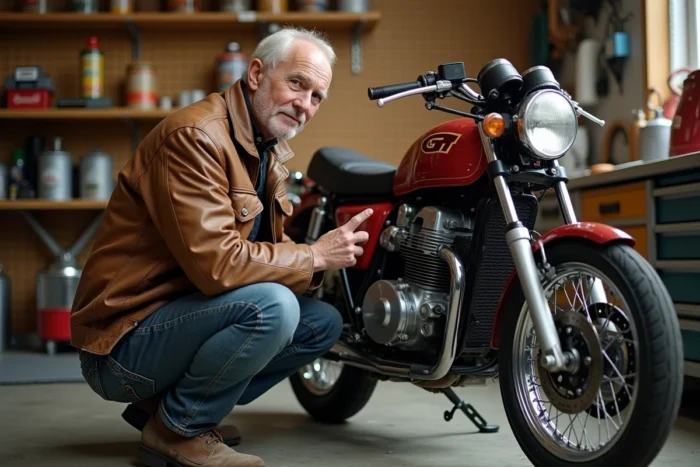
Since the implementation of technical inspections for motorized two-wheelers, the question of compliance has arisen with new urgency for owners of vintage machines. On a GT 750, there are many points of vigilance: original lighting often undersized compared to current standards, drum brake systems on early models (disc brakes only appearing on later versions), and emissions related to the two-stroke engine.
The classification as a collector vehicle significantly changes the equation. This status, accessible after a specific administrative procedure with the FFVE (Fédération Française des Véhicules d’Époque), allows for obtaining a collector registration. The practical advantages are concrete:
- Exemption from certain points of the technical inspection, particularly regarding pollutant emissions, which avoids a near-automatic blockage for a two-stroke engine of this generation
- Possibility to retain original equipment (lighting, switches, lights) without contemporary compliance
- Access to collector insurance, generally less expensive than standard motorcycle insurance, provided that an annual mileage limit is respected
The trade-off, as specialized guides remind us, relates to usage: a motorcycle classified as a collector is not meant to serve as a daily means of transport. For an owner considering regular outings on the road, this compromise deserves reflection before starting the process.
Reliability of the two-stroke three-cylinder engine after several decades
The engine block of the GT 750 is based on an unusual architecture: three inline cylinders, two-stroke, fed by three carburetors and cooled by a water circuit with a radiator. This relative complexity for a two-stroke explains both its smooth operation and its maintenance requirements.
Long-term owner feedback converges on a list of recurring points:
- The synchronization of the three carburetors requires precise and regular adjustment; otherwise, the engine runs unevenly and consumes excessively
- Leaks at the crankcase seals and cooling circuit almost systematically appear on machines that have been idle for long periods
- The electrical system, designed for the 1970s, struggles with the addition of modern accessories and shows weaknesses in battery charging
- A complete overhaul of the carburation and sealing is considered a necessary step after any purchase, regardless of the stated condition
Despite these constraints, the fundamental mechanics are described as solid by those who maintain them properly. The two-stroke three-cylinder offers flexibility and mid-range torque that many owners describe as remarkable for touring.
Riding pleasure and chassis limits on the GT 750
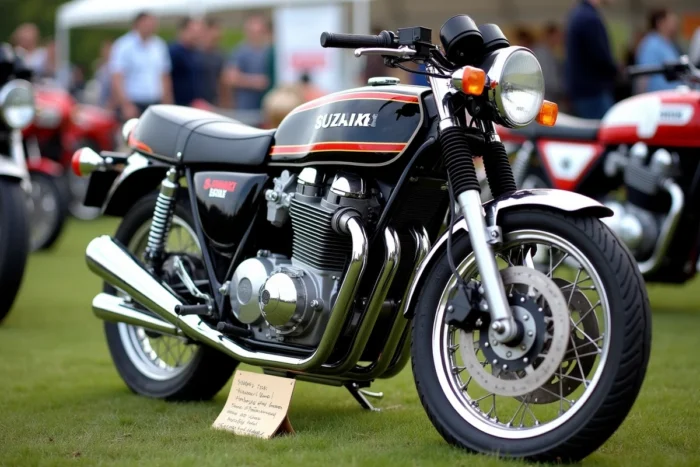
What emerges from the testimonies of owners who have accumulated thousands of kilometers is a strong attachment to the personality of the machine. The GT 750 is a born touring bike, not a sport bike. Its weight, upright riding position, and the gradual power delivery of its engine make it a companion for long journeys, provided you don’t ask it to do what it cannot.
The chassis, typical of its era, shows its limits in fast sequences. The modest ground clearance and rudimentary suspensions impose a measured pace in tight corners. On the highway or on country roads, the GT 750 finds its expression: a torque available without brutality, a comfortable position on the seat, and that characteristic sound of the two-stroke three-cylinder that enthusiasts describe as unique.
Owners who keep their GT 750 after many years rarely do so for financial calculations. It is the irreplaceable character of this engine, the last representative of an extinct lineage, that justifies the investment in time and parts.
The collector market confirms this: well-maintained examples, in documented original colors, find buyers without difficulty. The question for a potential buyer is not so much whether the GT 750 is a good motorcycle, but whether they are willing to accept the discipline it imposes.