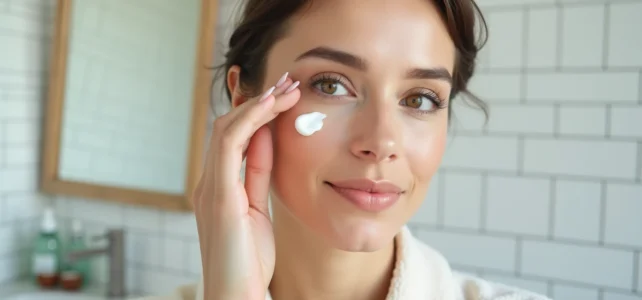
Your skin feels tight after the shower, your complexion looks dull by midday, and you’re unsure which product to apply first. These little inconveniences rarely stem from a lack of care. They often arise from a poorly calibrated beauty routine, with too many products or steps in the wrong order. Enhancing your beauty daily relies on a few simple principles, provided you understand why each step matters.
Skin-streaming: the simplified beauty routine that transforms your complexion
You may have noticed that some people use two or three products and have radiant skin, while others layer serums without results? This discrepancy can be explained by a principle highlighted by beauty trends for 2026 known as skin-streaming: fewer products, better chosen.
The idea is to limit your facial routine to a maximum of three or four products. A gentle cleanser, a moisturizer suited to your skin type, and sunscreen in the morning. In the evening, a night treatment with visible results replaces the layering of products. This selection prevents overloading the skin, which absorbs poorly when too many textures overlap.
To identify the products that suit your skin, simply access Pop Your Beauty and browse the categories by type of care and need.
Skin-streaming works because it reduces the risk of irritation. Each active ingredient has time to penetrate properly. A well-absorbed serum is better than three layers that slide over each other.

Order of application for facial care: the texture rule
Applying your products in the correct order is as crucial as the choice of products themselves. The basic rule is simple: always go from the thinnest texture to the thickest.
In the morning: protect and prepare the skin
After cleansing, the skin is ready to receive active ingredients. A watery serum goes first, followed by a face cream. Sunscreen is applied last, over everything else. It forms the final barrier.
Makeup is only applied after sunscreen, never between two treatments. Foundation applied over a still-damp serum will slide off during the day.
In the evening: repair and nourish the skin
In the evening, cleansing is the longest step. A thorough makeup removal eliminates residues of makeup, sunscreen, and pollution. A double cleanse (oil followed by foam) is suitable for skin that wears makeup. For others, a single pass with a gentle cleanser is sufficient.
After cleansing, a concentrated night treatment takes over. Skin cells renew during sleep, and the actives applied in the evening penetrate better than those applied in the morning.
Cosmetic allergens: reading labels in 2026
Since Regulation (EU) 2023/1545, the list of fragrance substances to be declared on cosmetic packaging has increased from 24 to over 80. This extension will come into effect on July 31, 2026, for all products sold in the European Union.
In practical terms, your creams, perfumes, and makeup products will display longer ingredient lists. This is good news for sensitive or allergic skin: you will be able to more easily spot the molecules that cause reactions.
- Check the INCI list (International Nomenclature of Cosmetic Ingredients) on the back of the product, especially the last lines where allergens are listed
- If your skin reacts to a fragrance or cream, note the common ingredients between the affected products to identify the culprit
- Favor short formulas, with fewer than 15 ingredients, which reduce the risk of contact with an unexpected allergen
This new labeling transforms reading packaging into a real prevention tool. Make it a habit before each purchase, especially for facial care and products that stay in contact with the skin for long periods.

PFAS-free products: what this changes for your beauty routine
PFAS, these persistent chemical compounds dubbed “forever chemicals,” are found in many cosmetics: long-wear foundations, smoothing masks, waterproof products. As of January 1, 2026, intentionally added PFAS are banned in cosmetics.
Why does this matter to you? Because PFAS-free alternatives change the texture and wear of certain products. A reformulated foundation may last slightly less long. A waterproof mascara may require a more effective makeup remover.
This doesn’t mean that products become less effective. Brands are reformulating with safer ingredients. You gain in safety what you may occasionally lose in marginal practicality.
Eye and lip makeup: adapting colors to your complexion
Beautiful makeup relies on a principle of controlled contrast. Warm colors (peach, copper, orange) suit golden undertones. Cool colors (pink, mauve, taupe) match better with rosy undertones.
Don’t know your undertone? Look at the veins on your wrist in natural light. Bluish veins indicate a cool undertone. Greenish veins signal a warm undertone. If you see both, your undertone is neutral, and most colors will suit you.
- For the eyes, a neutral base eyeshadow (beige or light brown) unifies the eyelid before applying a more pronounced color in the crease
- For the lips, a pencil in the same shade as the lipstick avoids visible demarcations over time
- A brown mascara, softer than black, softens the look on fair skin and gives a more natural effect
Successful daily makeup focuses on a maximum of two strong points: the eyes or the lips, rarely both at the same time. This choice avoids the “overdone” effect and maintains a natural glow throughout the day.
Everyday beauty is not built with an arsenal of products, but with precise gestures and formulas suited to your skin. The regulatory changes of 2026 go in the same direction: more transparency, less excess, and label reading that becomes your best beauty ally.