
Among the small passerines that inhabit hedges and foliage, several produce repetitive syllables that evoke the word “eight.” Identifying the one that emits this signal requires comparing the rhythm, pitch, and context of the sound. The willow warbler, the garden warbler, and the zizi bunting are the most frequently mentioned in discussions among amateur ornithologists, but their vocalizations follow very different patterns.
Willow Warbler, Garden Warbler, Zizi Bunting: Comparing Syllabic Songs
Three common species in French gardens produce brief, repeated notes that the human ear sometimes transcribes as “eight.” The table below gathers their vocal and physical characteristics to facilitate field identification.
| Criterion | Willow Warbler | Garden Warbler | Zizi Bunting |
|---|---|---|---|
| Common transcription of the song | “tsip-tsap” or bisyllabic “eight-eight” | High descending trill, contact call “tsii” | Dry and metallic phrase, sometimes reduced to a repeated note |
| Rhythm | Regular alternation of two syllables | Fast series of fine notes | Monotonous repetition on the same tone |
| Pitch | Medium-high | Very high | Medium |
| Main singing period | Late February to June | March to May | April to July |
| Preferred habitat | Underbrush, parks, shrub hedges | Tree trunks, wooded gardens | Edges, bocages, open gardens |
| Approximate size | Comparable to a blue tit | Smaller than a blue tit | Close to a sparrow |
The willow warbler remains the candidate most frequently associated with the transcription “eight-eight.” Its bisyllabic song, emitted from a clear perch in the vegetation, precisely corresponds to this onomatopoeia. To know which bird sings eight eight in a specific context, however, one must cross-reference the melody with the habitat and the observed silhouette.
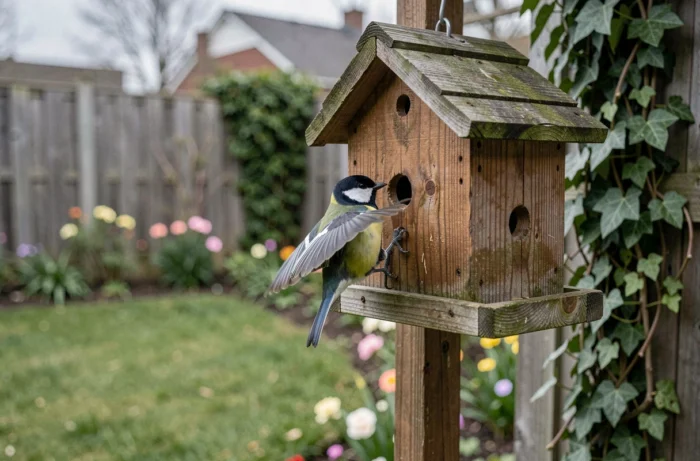
Willow Warbler: Why Its Bisyllabic Song Dominates Gardens
The willow warbler (Phylloscopus collybita) derives its English vernacular name, “chiffchaff,” from the direct transcription of its song. In French, “eight-eight” or “tsip-tsap” translate the same alternation of two notes, one slightly higher than the other, repeated continuously for long sequences.
This regular bisyllabic alternation constitutes the most reliable acoustic criterion. The garden warbler emits a continuous descending trill, with no clear pause between syllables. The zizi bunting, on the other hand, maintains a single note repeated on a metallic tone, without the characteristic pitch shift of the willow warbler.
Plumage and Posture: Confirming Visual Identification
The willow warbler is about the size of a blue tit. Its plumage is discreet, in olive-brown tones on top and paler underneath. The dark legs distinguish it from the chiffchaff, which has light legs.
The bird usually sings perched at mid-height in a tree or bush, clearly visible. It frequently flicks its tail up and down, a nervous reflex that aids in spotting even when the song stops.
- Olive-brown plumage above, whitish below, without marked wing bars
- Dark legs (unlike the chiffchaff with light legs)
- Tail flicked vertically almost constantly
- Faint, pale eyebrow
Progress of the Willow Warbler in Urban Parks Since 2010
Regional ornithological monitoring programs (like STOC) indicate that the willow warbler has been increasing in urban parks and gardens in France since the early 2010s. This colonization particularly affects the West and North of the country, where the species is settling in wooded parks and peri-urban fringes that it did not previously frequent.
In France and Belgium, long-term monitoring data report a stability or slight increase in populations. In contrast, some neighboring countries in Western Europe are recording a slight downward trend in areas subjected to recurrent spring droughts since the mid-2010s.
Earlier Singing in Spring: An Effect of Warming
Recent studies show that the willow warbler begins to sing earlier in spring than it did two or three decades ago. The date of the first song and first laying has advanced by several days in western Europe since the 1990s, directly linked to milder springs.
This precocity alters the observation window. An “eight-eight” heard as early as late February in a garden in northern France likely corresponds to a willow warbler, while the garden warbler and zizi bunting are less vocal at this time.

Identifying the “eight eight” Song Without an App: Elimination Method
A sound identification app (like BirdNET or Merlin) can confirm a species, but the ear alone is sufficient to rule out the most common confusions if one proceeds by elimination.
- Is the sound bisyllabic with a clear alternation of pitch? If so, the willow warbler is the main candidate
- Is the sound a continuous trill, very high, descending? The garden warbler is more likely
- Is the sound a single note repeated on a dry and metallic tone? The zizi bunting fits better
- Is the bird singing perched openly in a leafy tree, flicking its tail? This behavior confirms the willow warbler
The time of year also weighs into the analysis. The willow warbler sings from late February, well before most other passerines with a syllabic repertoire. In mid-summer, if the “eight-eight” song persists, it may be an unpaired male continuing to defend a territory.
Frequent Confusion with the Great Tit
The great tit produces a bisyllabic song (“ti-tu, ti-tu”) that is sometimes confused with that of the willow warbler. The difference lies in the deeper and more resonant tone of the tit, whose notes carry more. The willow warbler emits a thinner, more hesitant sound, with a slight rhythmic offset between the two syllables.
Habitat does not always allow for a clear distinction: both species frequent the same wooded gardens. Behavior remains the best indicator. The tit actively moves from branch to branch, while the willow warbler stays perched and flicks its tail without changing perches for long minutes.
The “eight-eight” song heard in a garden between February and June, emitted by a small olive passerine with dark legs that flicks its tail, designates in the vast majority of cases a willow warbler. Recent monitoring confirms that this species is gaining ground in urban areas, making this encounter increasingly common, even in places where it was absent a few years ago.