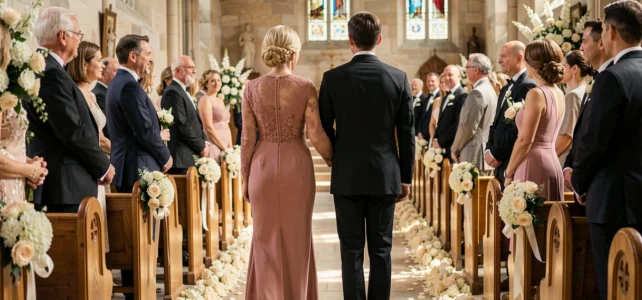
The musical choice for the parents’ entrance at a wedding raises questions of timing as well as repertoire. A piece that is too long dilutes the emotion, while a title poorly timed with the march creates an awkward gap. We recommend treating each parental entrance as a scripted sequence, with a precise breakdown of the chosen piece.
Musical Breakdown and Timing: The Technical Constraint That No One Details
The trend observed in 2026 confirms a practice that reception DJs have been applying for several seasons: cutting each piece to between 30 and 60 seconds to keep only the intro and the unifying chorus. For a parental entrance, exceeding one minute creates a floating feeling in the room.
The timing work involves identifying the exact entry point of the piece, often a few measures before the chorus, and programming a clean fade-out. A hybrid DJ set with instrumentalists allows for real-time tempo adjustments if the parents slow down or speed up their march.
We also observe that couples are increasingly requesting live or rearranged covers of classic soul and pop songs rather than the original studio versions. This “mini-concert” format for family moments gives a unique color to each entrance while keeping a title that the audience recognizes from the first notes. To learn more about La mariée de Sophie, the site details the musical selection criteria suited to each sequence of the ceremony.
Selection of 10 Songs for the Parents’ Entrance at the Wedding
Each title below has been chosen for its ability to work in a short format, its immediate recognition by a multigenerational audience, and its emotional register suitable for a parental entrance.
Francophone Register: Songs with Strong Emotional Charge
- Je vole, Michel Sardou: the chorus establishes itself in a few seconds and carries a direct filial emotion. Works particularly well for the entrance of the bride’s mother.
- Millésime, Pascal Obispo: a moderate tempo that accompanies a walk without forcing the pace. The lyrics evoke the passage of time, a perfect register for a father or mother.
- A ma fille, Charles Aznavour: sober and straightforward. The piano intro is enough to set the atmosphere. We recommend starting eight measures before the chorus.
- La Vie en rose, Édith Piaf: a classic recognizable from the first note. Ideal in a rearranged version by an acoustic trio to avoid the “cliché” effect.
Anglophone Register: Universal Pieces
- What a Wonderful World, Louis Armstrong: the instantly recognizable vocal grain creates a warm sound bubble. Works for both parents together.
- You Are the Sunshine of My Life, Stevie Wonder: pure Motown, natural walking tempo, unifying chorus. A safe choice for a joyful entrance.
- Can’t Help Falling in Love, Elvis Presley: the slow tempo imposes a solemn walk without rigidity. Live version on ukulele for a more intimate feel.
- My Girl, The Temptations: gentle energy, ideal for a father entering with his daughter. The chorus starts quickly, simplifying the timing.
- Heroes, David Bowie: a less expected choice, but the crescendo of the chorus accompanies an entrance that builds in intensity. Reserved for couples who embrace a rock register.
- I Loved Her First, Heartland: melodic country designed for the father-daughter bond. The lyrics fit the moment unambiguously.
Adapting the Musical Choice to the Ceremony Format
The venue and type of ceremony radically change the impact of the same title. A song that works in a reception hall with professional sound can fall flat under a church vault where reverberation drowns out the lyrics.
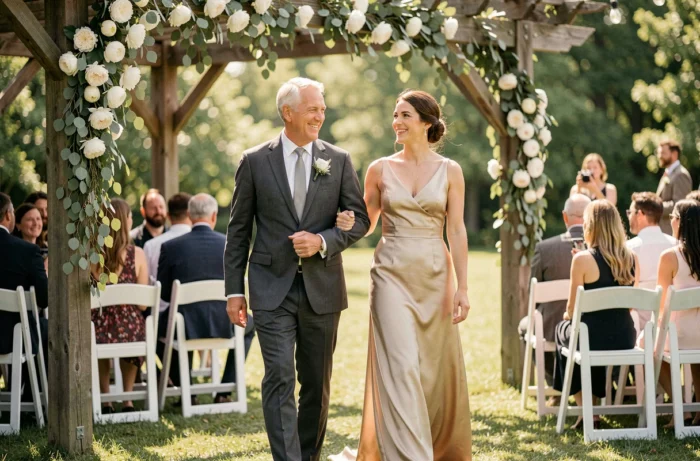
For an outdoor secular ceremony, we favor pieces with a strong melody and secondary lyrics. Wind, ambient noise, and sound dispersion reduce vocal intelligibility. A title like What a Wonderful World works better than a spoken text by Sardou in this context.
Indoors, acoustic control allows for playing with nuances. This is the ideal setting for live covers: a pianist starting A ma fille solo before the rest of the group joins in on the chorus creates a calibrated emotional build-up.
The common mistake is choosing the piece without testing the sound in the actual venue. We always recommend a technical visit with the DJ or group, microphone in hand, to check sound propagation and adjust the attack volume.
Parental Playlist and Music Rights: What the Venue Changes
A often overlooked point: playing music at a private wedding in a private venue does not require a declaration to SACEM. The fee only becomes mandatory when the event is open to the public or for profit, with paid entry or sale of refreshments.
In practice, the majority of weddings in rented halls remain private invitation-only events. The provider (DJ, band) usually has its own licenses for sound. Check that your service contract includes coverage for broadcasting rights to avoid any gray areas with the venue manager.
For couples who wish to share a video montage including the entrance songs on social media after the wedding, the question of rights arises differently. Online publication of a recording containing protected music falls under classic copyright law, regardless of the private nature of the initial event.
The choice of a song for the parents’ entrance is not just a matter of taste. The timing for a short format, the acoustic test on-site, and the verification of broadcasting rights are three technical steps that transform simple background music into a mastered moment.