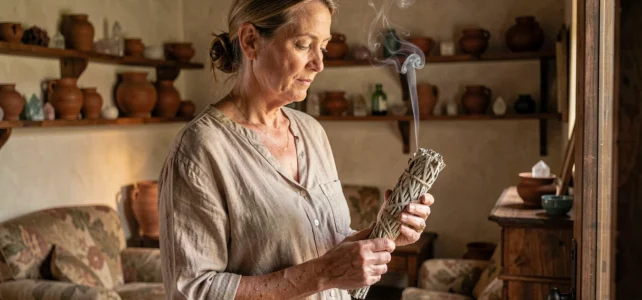
White sage, coarse salt, palo santo: articles on energy cleansing often recommend burning plant substances to drive away bad spirits from a home. Several French health agencies classify incense and candles among the sources of indoor pollution, not among the purification solutions.
Comparing these approaches requires considering two criteria that are rarely intersected: the desired effect on the atmosphere of the place and the measurable impact on the quality of the air breathed. This is the angle that this article explores.
Fumigation and indoor pollution: what health authorities say
Since the summer of 2026, several regional health agencies (ARS) and Anses have reminded in their recommendations that candles and incense are sources of fine particles and volatile organic compounds. These advisories have been reinforced during smoke episodes from fires, but they apply to all domestic use, including during normal periods.
Several public reports classify incense in the “highly polluting” category. Stick diffusers, which do not generate combustion, are considered less aggressive for the respiratory tract.
For those seeking methods to drive away bad spirits without degrading the ambient air, this distinction changes the hierarchy of recommended practices. Burning white sage or palo santo releases smoke comparable to that of incense, placing these rituals in the same risk category.
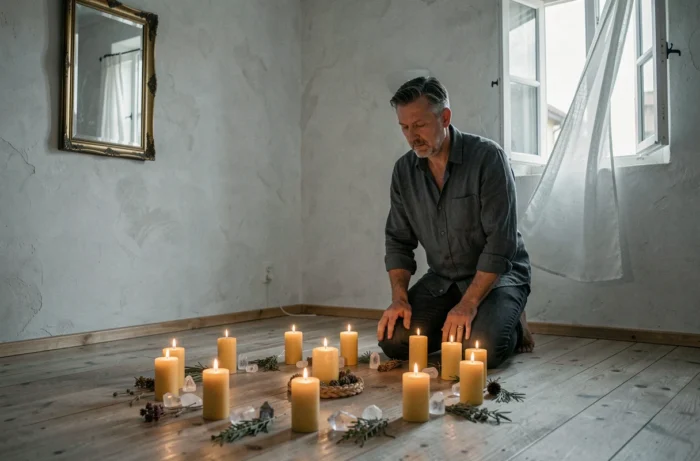
Comparative table of energy purification practices
The table below crosses the seven most common approaches with three criteria: combustion (yes/no), the level of risk for indoor air quality, and the most frequently cited associated tradition.
| Method | Combustion | Indoor pollution risk | Associated tradition |
|---|---|---|---|
| Fumigation with white sage | Yes | High | Native American |
| Palo santo wood | Yes | High | South American |
| Incense (sticks, cones) | Yes | High | Multiple (Asian, Christian) |
| Coarse salt placed in rooms | No | None | Mediterranean, Feng Shui |
| Stick diffusers (flame-free) | No | Low | Contemporary aromatherapy |
| Sounds and mantras (Tibetan bowl, recitation) | No | None | Buddhist, Vedic |
| Crystals and protective stones | No | None | Lithotherapy, New Age |
Three of the seven most recommended methods online involve direct combustion. The four combustion-free alternatives emit no measurable fine particles, making them compatible with current health recommendations.
White sage and palo santo: the issue of over-exploitation
Beyond indoor pollution, a second problem arises for the two most popular plants in purification rituals. Global demand for white sage (Salvia apiana) and palo santo (Bursera graveolens) has significantly increased in recent years, driven by social media and the wellness market.
Voices within Native American communities denounce a form of cultural appropriation. The harvesting of white sage is linked to specific sacred ceremonies, and its mass commercialization raises ethical questions documented by several North American indigenous associations.
Palo santo requires a tree that has been dead for several years to develop its aromatic properties. Commercial pressure pushes some suppliers to harvest green wood, which is less fragrant and comes from unsustainable cuts. Traceability labels remain rare in this market.
These two elements (health impact and ecological pressure) paint a simple picture: the most publicized fumigation practices accumulate the drawbacks that their alternatives avoid.

Coarse salt and sound purification: two combustion-free approaches to consider
Coarse salt is the most accessible and least controversial method. Mediterranean traditions and Feng Shui recommend placing bowls of coarse salt in the corners of rooms and replacing them regularly. No pollutants are released, the cost is negligible, and the ritual raises no questions of cultural appropriation.
- Place the salt in open containers, preferably at the corners of each room and near entrances, then replace it weekly
- Do not reuse the salt after exposure: dispose of it in running water or in the toilet, according to traditional usage
- Combine the salt with a complete airing of the house (windows open for at least fifteen minutes), which is the only air purification recognized by health authorities
Sound purification (Tibetan bowl, bell, recitation of mantras) is based on a vibrational principle. No chemical emissions, no waste, no plant resources consumed. In Buddhist tradition, the mantra “Om Mani Padme Hum” is used as a formula for emotional purification of the space.
Energy cleansing and ventilation: what rituals cannot replace
Regardless of the method chosen, one point remains constant in the recommendations of the ARS: opening windows remains the only scientifically validated air purification gesture. Fumigations, even when performed with reputedly purifying plants, add pollutants to an enclosed space.
- Ventilate each room daily, even in winter, for at least ten to fifteen minutes
- Never perform a fumigation with windows closed: the concentration of fine particles increases very quickly in a non-ventilated space
- After any ritual combustion, extend ventilation beyond the usual time to clear residues
Energy cleansing and indoor air hygiene are two distinct approaches. Confusing them amounts to degrading air quality in the name of purification.
The choice of a purification method benefits from integrating these health and ecological data. Coarse salt, sound, and daily ventilation cover both the ritual dimension and the requirements for indoor air quality.