
The French DIY and gardening market has contracted over the past two years. Purchases are refocusing on home maintenance and enhancement rather than purely decorative projects. This trend is changing the approach to domestic projects: the choice of materials, the durability of tools, and even water management in the garden now adhere to regulatory and economic constraints that most practical guides overlook.
Repairability of powered tools: a game-changing requirement at the time of purchase
Since 2023, certain powered DIY and gardening tools sold in France must have spare parts available for at least five years. These parts can come from the circular economy, which opens the door to repairs that are less costly than a complete replacement.
This requirement alters the calculation when choosing a drill, a brush cutter, or a hedge trimmer. A slightly more expensive model, made by a brand that structures its spare parts network, becomes more cost-effective over time than a budget device whose motor or battery is irreplaceable.
Before purchasing, check if the manufacturer clearly states the duration of spare parts availability. Physical and online stores are beginning to integrate this information into their product sheets. By browsing all the articles from Brico Déco Jardin, you will find comparisons that include this repairability criterion alongside price and power.
The classic reflex of accumulating cheap tools is losing its relevance. It is better to build a small kit of repairable and versatile tools than a collection of disposable devices.
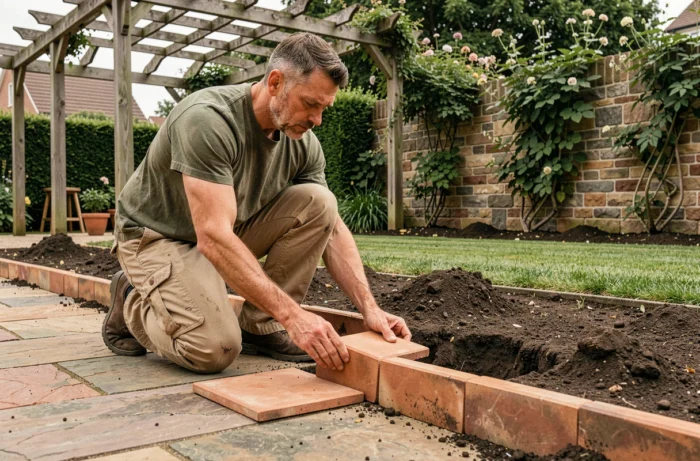
Watering restrictions and garden projects: adapt the plan before planting
Garden projects can no longer ignore local water restrictions. The French system includes four levels of restriction: vigilance, alert, reinforced alert, and crisis. At the last stage, watering lawns, flower beds, and potted plants may be completely prohibited.
These rules can change within days, depending on prefectural orders. The VigiEau platform allows you to check the applicable level for your municipality. Starting a landscaping project without checking these constraints risks a wasted investment as soon as the first dry summer arrives.
Three practices for a resilient garden in the face of restrictions
- Thick mulching around plants significantly reduces evaporation and limits the need for watering, even in full heat.
- Micro-irrigation (drip irrigation) concentrates water on the roots of young trees, hedges, and vegetable gardens, where it is truly needed.
- Accepting a yellowed lawn in summer avoids considerable water waste. The grass naturally greens up again with the return of autumn rains, without intervention.
The design of a resilient garden gradually favors these approaches. The goal is not to abandon aesthetics but to concentrate resources on priority plantings rather than maintaining a constant summer appearance everywhere.
Indoor DIY: prioritize projects that sustainably enhance the home
In a context where budgets are tightening, field reports converge: homeowners are directing their spending towards work that improves daily use or the longevity of the building. Re-insulating a room, replacing a damaged tile joint, or installing a durable floor covering takes precedence over simple decorative makeovers.
This approach does not mean abandoning decor. It involves combining utility and aesthetics in the same project. For example, repainting a room while incorporating anti-humidity treatment on north-facing walls, or choosing a decorative coating that also improves sound insulation.
Materials and safety: two angles often overlooked by occasional DIYers
The choice of materials determines the project’s lifespan. A budget coating that flakes after two winters costs more than a quality product applied just once. Read the technical sheets, compare yields per square meter, and check compatibility with the existing substrate.
On the safety side, protective glasses and dust masks remain the major oversights of amateur projects. Cutting wood, sanding, or handling chemical products generates splashes and fine particles whose effects on the respiratory system are well documented.

Extended producer responsibility: what REP systems change for your construction waste
Extended producer responsibility (REP) for construction products and materials requires manufacturers to finance the collection and treatment of waste from their products. For an individual renovating, this translates into easier access to collection points for rubble, leftover paint, material packaging, and certain furniture items.
In practice, field reports vary on the ease of access to these collection points depending on the regions. Rural areas are less well covered than urban areas. Check with your local waste disposal site before starting a project to find out which materials are accepted and under what conditions.
Sorting DIY waste is no longer optional: it is a legal obligation whose non-compliance can lead to fines. Integrating this step into project planning, just like purchasing supplies, avoids unpleasant surprises at the end of the project.
DIY, decor, and gardening are undergoing a silent transformation. Regulations on repairability, water, and waste are reshaping the concrete choices that each individual must make even before opening their toolbox. Taking these constraints into account from the planning phase is what separates a successful project from a site that needs to be redone the following year.