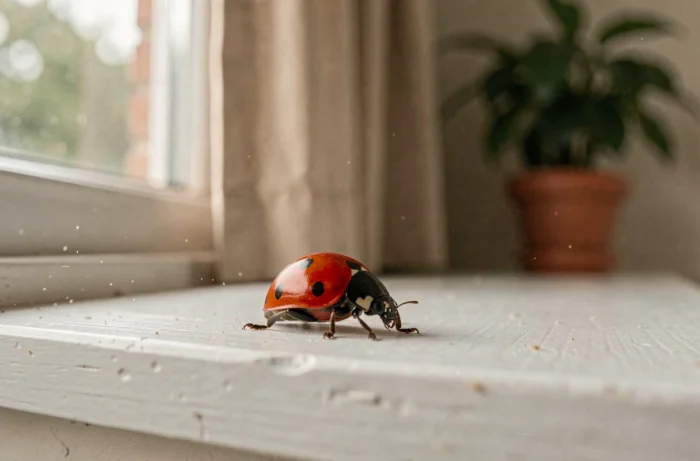
When dozens of ladybugs gather on a window frame or in the corner of a ceiling in the fall, the phenomenon is not mystical. It is a specific biological behavior: the search for a dry and temperate hibernation site. Understanding which species is involved, why it chooses your home, and what real risks exist allows for a reaction without panic or unnecessary actions.
Asian ladybug or local species: an identification not to be rushed
The majority of massive gatherings observed in homes in France and Belgium correspond to the Asian ladybug (Harmonia axyridis). Introduced in Europe for biological control against aphids, this species has the particularity of seeking shelter in buildings rather than under bark or in leaf litter.
Contrary to a common belief, color and the number of spots are not sufficient to identify the species. Harmonia axyridis exists in many forms, from pale yellow to almost solid black, with a highly variable number of spots. The most reliable indicator remains the dark M or W-shaped pattern on the pronotum, the small plate located just behind the head.
Concluding that a ladybug is native because it is red, or Asian because it is orange, leads to frequent mistakes. Only examining the pronotum and, in ambiguous cases, the size (the Asian is noticeably larger than the seven-spotted ladybug) can provide clarity. Interpreting the presence of ladybugs in the house first involves this identification step, as the consequences and the course of action differ depending on the species.

Ladybugs in the house in autumn: the aggregation mechanism
An isolated ladybug that entered through an open window in summer does not have the same significance as a gathering of several dozen individuals at the end of autumn. In the latter case, the behavior follows a specific biological cycle.
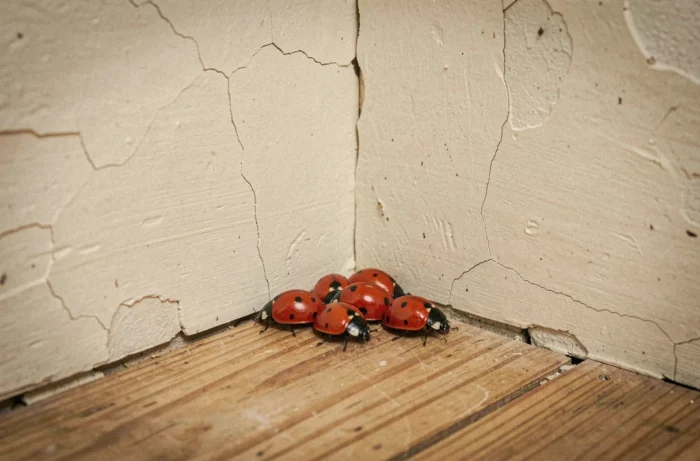
As temperatures drop, Asian ladybugs seek hibernation sites. They are attracted to light surfaces exposed to the sun at the end of the day (south and west facades), then they infiltrate through cracks, the gaps of windows, roller shutter boxes, or attics. Once inside, they release aggregation pheromones that attract other individuals to the same spot.
The goal is neither to feed nor to reproduce. Ladybugs enter diapause, a dormant state that slows their metabolism. They do not lay eggs in the house and are not interested in wood, textiles, or foodstuffs. In spring, they naturally return outside.
Allergic risk related to Asian ladybugs: an underestimated point
The Asian ladybug secretes a yellowish, foul-smelling liquid when it feels threatened, which can stain walls and clothing. This is not just an aesthetic inconvenience.
Proteins present in these fluids can cause documented allergic reactions in some sensitive individuals:
- Rhinitis and conjunctivitis, similar to symptoms of a dust mite allergy
- Contact urticaria after handling the insects with bare hands
- Worsening of asthma when allergens are found in indoor dust, in cases of high aggregation
These cases remain confined to situations where the insects are very numerous and to individuals already prone to respiratory allergies. A handful of ladybugs poses no health risk. However, in the case of a gathering of several hundred individuals in an attic or a shutter box, the allergic risk justifies a quicker response.
Reacting without insecticide: concrete actions that work
The most common mistake is to crush ladybugs. The defensive liquid released leaves stubborn stains and disperses allergens. A vacuum cleaner (with a stocking or fine cloth attached to the nozzle to avoid harming them) remains the most effective way to remove a group without damage.
Preventing entry before autumn
Sealing points of infiltration yields the best results, provided action is taken before the first gatherings:
- Apply silicone sealant on facade cracks, worn window seals, and cable passages
- Check window screens (a fine mesh blocks ladybugs without harming ventilation)
- Close roller shutter boxes with brush seals or sealing strips
- Reduce outdoor nighttime lighting, which attracts insects to the facades
No insecticide is recommended, neither by naturalist associations nor from a common-sense perspective: ladybugs, including the Asian one, remain effective predators of aphids in the garden. Eliminating them chemically amounts to destroying a free biological control agent.
Essential oils: real effectiveness or placebo
Peppermint is often cited as a natural repellent. A few drops placed on window sills or passage points can discourage ladybugs due to the strong smell. The effect remains limited in time and requires regular renewal. Mechanical sealing is significantly more reliable than any olfactory repellent.
Ladybugs and local biodiversity: a fragile balance
The Asian ladybug poses a serious ecological problem outside homes. A generalist predator, it consumes the larvae and eggs of other native ladybug species, in addition to aphids. In several regions of France and Belgium, populations of local species (two-spotted ladybug, seven-spotted ladybug) have declined since the establishment of Harmonia axyridis.
Releasing captured Asian ladybugs in the garden does not solve this problem, but killing them en masse does not change anything either on the scale of a population established for decades. The priority remains to limit their access to buildings through mechanical means, without disturbing the species that hibernate in the vegetation.
An autumn gathering of ladybugs on a facade primarily signals a lack of building airtightness. Sealing these weak points before the first cold fixes the problem for several seasons, without chemicals and without harming beneficial populations in the garden.