
The term “employee shop” encompasses various realities: local businesses with a few employees, independent food brands, or sales points linked to a works council (CSE). Regardless of the format, these structures share a common challenge: to offer tangible benefits to their teams while managing tight operating costs.
The regulatory framework surrounding restaurant vouchers and social benefits is constantly evolving, complicating matters for small structures without a dedicated HR service.
Restaurant vouchers and the 2026 reform: what changes for small businesses
Since 2022, the exemption allowing the purchase of all food products (pasta, meat, flour) with restaurant vouchers has been extended until December 31, 2026. This measure has broadened the scope of use well beyond prepared meals.
For a food shop employing a few staff, this extension has had a direct effect on the average basket size. Customers pay a larger share of their groceries with digital vouchers, which implies that the business must be equipped accordingly.
The reform proposals also foresee the elimination of year-end discounts paid by certain issuers to large companies. This mechanism, not very visible to the general public, alters the economic balance of the commissions charged to merchants. Small brands, which have never benefited from these rebates, could paradoxically find themselves on a more equitable playing field against large retailers.
However, the uncertainty regarding the continuation of the “all food” exemption after 2026 creates strategic ambiguity. A business that has adapted its offerings and communication around this possibility may need to revise its approach if the regulations revert to the previous framework.

Operational support for an employee shop: the real needs
Comparisons of employee benefit platforms focus on software features and monthly fees. They overlook a central angle for small structures: daily operational support.
Specifically, a shop with a few employees needs a service foundation that goes beyond distributing gift vouchers. Being able to rely on services for an employee shop at Club Entrepreneur helps cover needs ranging from administrative management to social compliance.
Field feedback varies on this point: some structures find their needs met by a turnkey outsourced CSE platform, while others prefer modular support tailored to their size. Concrete needs can be categorized into several areas:
- Implementation and management of digital restaurant vouchers, including training cashiers on compatible terminals
- Access to ticketing or negotiated discounts, even without a formal works council, to retain teams
- Regulatory monitoring of social benefit exemption thresholds, which change every year and expose employers to URSSAF adjustments in case of errors
- Assistance in managing the social budget: balancing between restaurant vouchers, gift vouchers, and bonuses without exceeding tax limits
Outsourced CSE for small businesses: limitations and points of caution
Outsourcing the CSE appeals to small shops that lack the time or expertise to manage a social committee internally. The principle is simple: a provider takes care of ticketing, benefits, and sometimes social communication, in exchange for a monthly subscription per employee.
This model offers a real advantage of simplicity. However, the cost per employee weighs more heavily in a structure of five people than in a company of two hundred. Fixed costs (platform subscription, setup fees) are spread over a small workforce, which can make the system less profitable than expected.
Another point deserves attention: customization. Platforms designed for large volumes offer standardized catalogs. A shop located in a rural area, where employees do not have access to the same leisure facilities as in metropolitan areas, may end up with a discount catalog that is not very relevant.
Selection criteria for a small structure
Before subscribing to an outsourced solution, three questions deserve clear answers:
- Does the provider charge per employee or at a flat rate, and what is the break-even point for a workforce of fewer than ten people?
- Is the benefits catalog geographically adaptable, or is it a uniform national offer?
- Does the service include active legal monitoring of exemption thresholds and reporting obligations?
The available data do not allow for the designation of a universal model. The choice depends as much on the budget as on the location and profile of the employees.
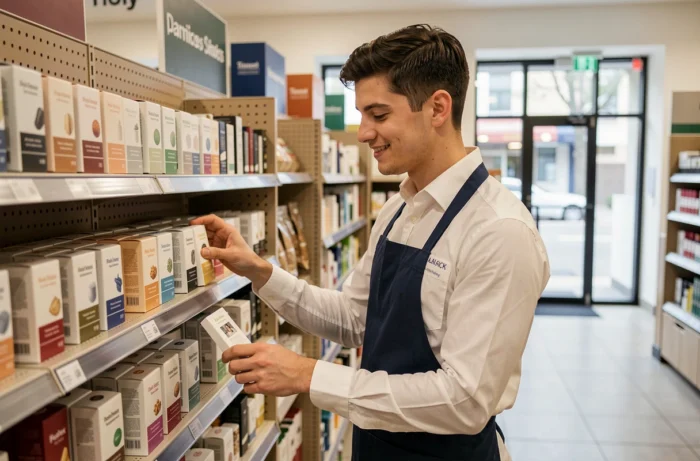
Employee benefits in shops: beyond purchasing power
In retail, where turnover is structurally high, the issue of employee benefits takes on particular significance.
For a shop, retaining a trained salesperson costs less than recruiting a new one. Social benefits then become a retention tool as well as a supplement to compensation. Restaurant vouchers, cultural vouchers, value-sharing bonuses: each mechanism serves a different purpose.
The challenge lies in internal communication. In a small structure, this problem should be simpler to resolve, provided the employer takes the time to clearly explain what is available.
An unused benefit is a wasted budget. Displaying the benefits in the break room, reminding employees during annual reviews, sending a quarterly summary via email: these simple gestures cost nothing and significantly increase the usage rate.
The success of an employee shop is not measured solely by revenue. The ability to maintain stable, trained, and motivated teams conditions the quality of service perceived by customers. Benefit mechanisms, even modest ones, directly contribute to this balance, provided they are chosen, sized, and communicated methodically.