
The sales in London do not follow the same regulatory framework as in France. The United Kingdom does not impose any official dates set by the state: each retailer freely decides when to launch, how long to run, and the level of its discounts. This absence of a legal calendar changes the way to plan a shopping trip in the British capital.
Sales in London and regulation: a system without imposed dates
In France, sale dates are set by ministerial decree. In London, there is nothing comparable. Retailers can launch their promotions whenever they wish, extend them, or interrupt them without administrative constraints.
This freedom has a direct consequence: discounts often start before traditional periods. The ONS (Office for National Statistics) noted in 2026 that non-food sales volumes were influenced by promotional activity starting earlier than usual, particularly from June. The peak of good deals is no longer concentrated solely on Boxing Day or January.
European rules on reference pricing now more strictly regulate displayed discounts. A retailer announcing a price drop must base it on the lowest price charged in the previous thirty days. Finding the details of the sales in London on Fashionova helps to better understand the actual promotion calendar by retailer.
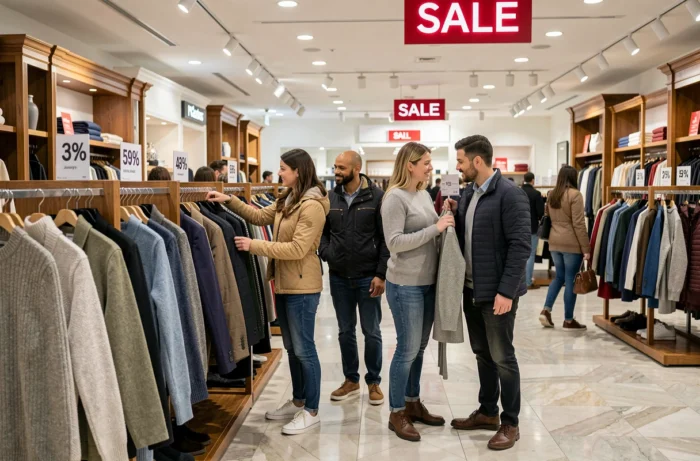
Boxing Day and winter sales: changes in store openings
December 26 remains the historical marker for winter sales in London. However, several major retailers have chosen not to open on Boxing Day. Retail Gazette reports that Aldi, John Lewis, M&S, and Waitrose were among the chains closed on Boxing Day 2025.
This trend modifies the strategy of shoppers. December 26 is no longer synonymous with a general rush in all stores. Some retailers compensate by launching online sales as early as the evening of the 25th, while others postpone their discounts until December 27.
Practical consequences for a shopping trip
As Boxing Day is a public holiday, public transport operates on reduced schedules. The subway and buses run less frequently. Planning central accommodation limits travel and avoids wasting time between two shopping districts.
Winter sales generally extend until the end of January. The biggest discounts often appear in the last weeks when retailers are looking to clear their remaining stock.
Summer sales in London: a lesser-known but strategic period
Summer sales usually start in June or July. Less publicized than winter sales, they still offer comparable discounts on spring-summer collections.
The competition between early promotions and traditional sales blurs the calendar. British retailers launch clearance operations as early as late spring, which sometimes reduces the extent of price drops during the official sales. Checking prices a few weeks in advance helps to determine if a discount displayed in July corresponds to a real reduction.
Items to target during the summer sales
- Pieces from British designers, whose prices drop significantly at the end of the season, especially in independent shops in Shoreditch and Notting Hill
- Vintage fashion items in markets like Camden Market or Portobello Road, where some stalls align their prices with the sales period
- Shoes and accessories in department stores, which free up space for autumn-winter collections

Payment and tax refund: optimizing the shopping budget in London
Since the United Kingdom left the European Union, EU resident travelers no longer benefit from the tax refund system (VAT Retail Export Scheme) as it existed before. The British government has suspended this scheme, meaning that VAT (currently applied to most consumer goods) remains included in the price paid.
The method of payment also deserves special attention. Almost all London shops accept contactless payment. Using a bank card without foreign transaction fees avoids commissions on each transaction.
Exchange rates and impact on prices
The euro/pound sterling exchange rate fluctuates and can turn a good deal into a price equivalent to that practiced in France. Comparing the discounted price converted into euros with the French price of the same item remains the most reliable reflex to assess the reality of a promotion.
Shopping strategy during sales in London
The shopping districts in London do not all offer the same type of discounts. Rather than running around everywhere, targeting two or three areas based on priorities saves time and money.
- Oxford Street and Regent Street concentrate major international brands with standardized price reductions, suitable for those looking for accessible brands in volume
- Bond Street and the adjacent streets of Mayfair cater to high-end fashion shoppers, with rarer but sometimes substantial discounts on designer pieces
- The eastern London districts (Shoreditch, Brick Lane) offer vintage and young designer shopping, with already low prices outside of sales and additional discounts during clearance periods
The omnichannel model pushes retailers to align their prices online and in-store. Checking a retailer’s website the day before a store visit helps to identify available pieces and verify that the price displayed in-store matches that online.
The sales in London mainly reward shoppers who prepare their itinerary, check reference prices, and are willing to shift their visit by a few days from the media-launched Boxing Day or summer promotions. The best value for money is rarely found on the first day.