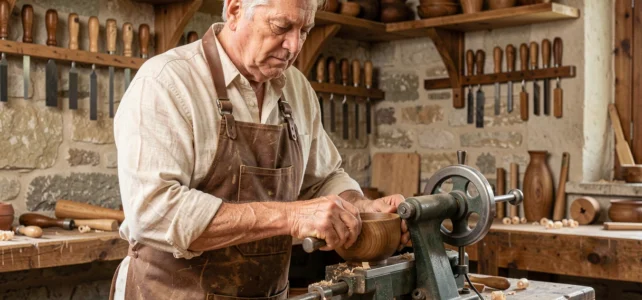
When searching for a bag, a belt, or a decorative object that doesn’t resemble anything found in supermarkets, one often ends up discovering a French artisanal workshop. The instinct is logical: behind each piece, there is a choice of material, a technical gesture, and a production time that industrial manufacturing cannot replicate.
It remains to understand what concretely distinguishes these artisanal creations, beyond the discourse on heritage and tradition.
Career Change and Craftsmanship: The Profile of New Creators
The ISM/MAAF 2025 barometer indicates 278,700 new artisanal businesses created in 2024, representing an 11% increase over one year. This figure exceeds the average growth of the entire economy.
The notable fact is that nearly half of the creators come from another profession. They leave the tertiary sector, IT, or large retail to train in leather goods, ceramics, or woodworking. They are not heirs of family workshops: they are professionals who choose craftsmanship after ten or fifteen years of career.
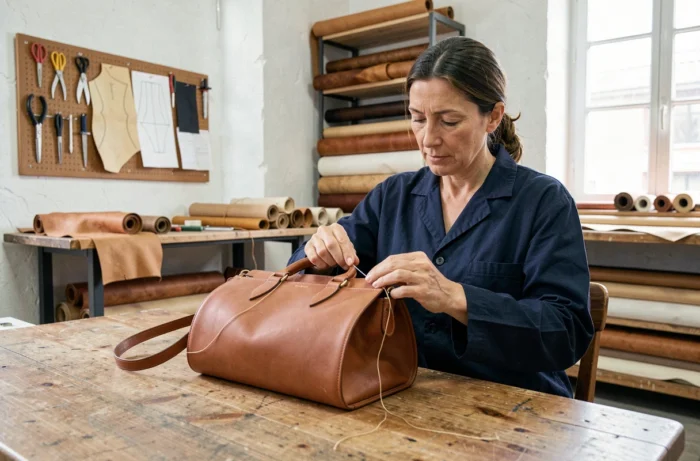
This profile changes the way objects are designed. A former engineer who ventures into saddlery brings prototyping reflexes, material strength testing, and process documentation. This type of approach can be found on lateliersingulier.fr, where technical rigor accompanies the artisanal gesture to produce leather accessories designed to last.
This wave of career changes also explains why the artisanal offering has diversified so much in recent years. We are no longer just talking about pottery or cabinetmaking: creations now cover stationery, cutlery, technical textiles, and contemporary jewelry.
Materials and Craft Techniques: What Makes an Object Durable
A French artisanal object is not durable just because it carries a “handmade” label. Its longevity depends on concrete choices made before production.
The Choice of Leather and Raw Materials
In leather goods, the quality of the leather is verified by touch and thickness. An artisan selects their hides from tanneries, often in France or Italy, checking for grain consistency and the absence of surface defects. A well-tanned full-grain leather develops a patina over time instead of degrading.
For wood, ceramics, or metal, the logic is the same: the artisan controls the origin, stores materials under suitable conditions, and rejects batches that do not meet their criteria. This sorting represents a cost, but it guarantees the object’s durability over several years.
Assembly and Manual Finishing
The difference between an industrial product and an artisanal product often lies in the finishing touches. We can list the steps that make a difference on a leather item:
- Edge trimming, which involves thinning the leather in folding areas to achieve clean corners without excess thickness
- Saddler stitching, done with two needles, which remains strong even if one stitch breaks (the thread does not unravel in a chain)
- Edge burnishing, applied in several layers by hand, which protects the leather from moisture in the most exposed areas
These finishes take several hours per piece, whereas an industrial machine processes the same volume in a few minutes. The result is visible and felt by touch.
Craftsmanship and Rural Areas: A Concrete Economic Role
Artisan craftsmanship is often associated with large cities, with the creative districts of Paris or Lyon. The reality of the figures tells a different story.
The regional ISM/MAAF barometers show that the number of artisanal businesses is growing significantly in regions with stagnant demographics. The Grand Est region shows a 24% increase over five years, while Bourgogne-Franche-Comté has a 21% increase over the same period. In these areas, craftsmanship represents up to 31% of all businesses.
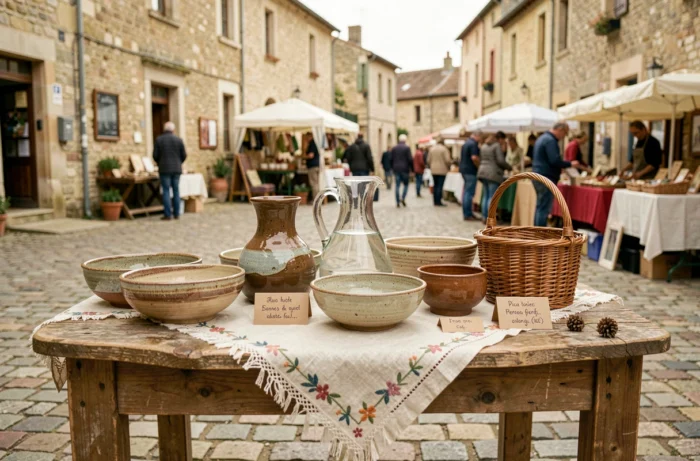
For a rural community, a leather goods or ceramics workshop creates a few jobs, generates visits (open houses, creator markets), and maintains a local economic activity that neither online commerce nor large retail can replace. The artisan purchases their supplies nearby when possible, uses local providers for logistics, and participates in local events.
Feedback varies on this point, but several artisans based in rural areas report that their main difficulty is not a lack of clientele (online sales compensate for low local foot traffic) but rather access to ongoing training and specialized suppliers.
French Craft Labels: Which Ones to Check Before Buying
When looking to purchase an artisanal creation and ensure its origin, one encounters several labels. Not all guarantee the same thing.
- The title of Master Artisan is awarded by the chamber of trades. It certifies a level of training (master’s degree or equivalent) and at least two years of experience in the profession
- The Living Heritage Company (EPV) label, awarded by the State, distinguishes companies that possess a rare, recognized, and economically viable know-how. The processing of the application takes several months and includes an on-site audit
- The “Artisan d’Art” designation applies to professionals registered in the crafts directory, which includes 281 specialties ranging from gilding to lutherie
The presence of one of these labels on a creator’s website or in their workshop provides reliable information. The absence of a label does not mean the work is of poor quality, but it requires verifying the traceability of materials and the conditions of production.
Sustainable Artisan Creations: What Justifies the Price
The price of a French artisanal object often surprises at first glance. A handmade leather wallet costs three to five times more than an industrial model. This ratio can be explained by cumulative factors.
The production time per piece is measured in hours, not minutes. The cost of manually selected raw materials is higher. The workshop does not benefit from economies of scale. And French social charges apply fully, unlike outsourced productions.
In return, a well-maintained artisanal object often lasts a decade or more. When calculated per year of use, the price difference with an industrial product replaced every two years decreases significantly. Buying artisanal means investing in an object that does not need to be repurchased.
It is also a consumption model that produces less waste, fewer returns, and less intercontinental transport. For those looking to reduce their footprint without sacrificing quality, French craftsmanship offers a concrete and verifiable response.