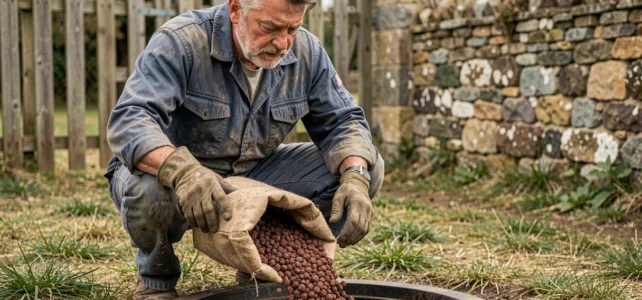
Pumice is a porous volcanic rock, red or black, found in the pre-filter basket of many septic tanks and all-water pits. Its alveolar structure retains solid particles before they reach the treatment system. This natural material is appealing due to its simplicity, but its use has concrete limitations that product sheets rarely mention.
Clogging of the pumice pre-filter: the real weak point
The main criticism of pumice concerns its tendency to clog. The alveoles that give it its filtering power gradually become blocked due to the accumulation of fats, organic matter, and sludge. When the pre-filter basket is saturated, water no longer flows properly to the drainage or compact filter.
A clogged pre-filter can cause backflow in the tank, even leading to visible overflow on the surface. On specialized forums, homeowners describe baskets that are completely obstructed, having remained closed for years without any maintenance. An unmaintained pre-filter basket will always end up blocking the system.
To avoid this scenario, it is necessary to regularly check the condition of the pumice. A recent technical guideline recommends a visual inspection at least every two years. The pumice should be rinsed with clean water during each tank emptying, and replaced when rinsing is no longer sufficient to unclog it. In practice, a complete replacement occurs approximately every seven to nine years according to the technical sources consulted.
Why does this timeframe vary so much? Because it depends on the volume of wastewater, the presence or absence of a grease trap upstream, and the type of products discharged into the pipes. A household that uses wipes or aggressive chemical products accelerates the degradation of the pre-filter.
To better understand these mechanisms and the precautions to take, some guides detail pumice for septic tanks with Envies de Jardin, also addressing its uses in the garden.
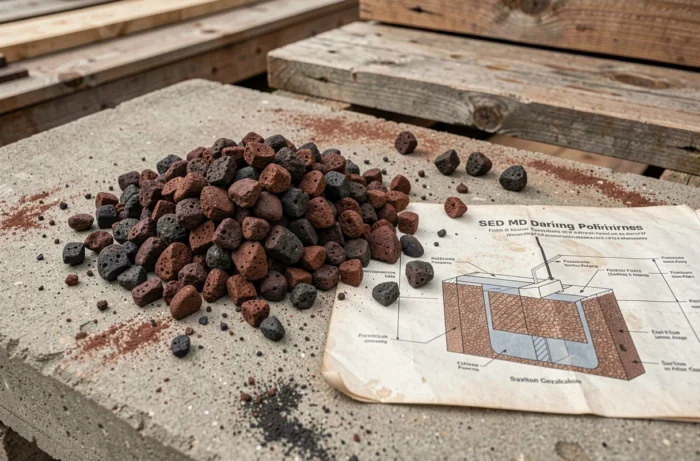
Pumice and filtration: what the volcanic rock does well
Pumice is not without its merits. Its natural porosity makes it an ideal support for purifying bacteria. These microorganisms colonize the cavities of the rock and contribute to the biological degradation of organic matter present in wastewater. The pre-filter is not just a mechanical sieve: it also plays an active biological role.
This dual mechanism, physical filtration and bacterial activity, distinguishes pumice from molded plastic pre-filters. The latter retains particles but offers less surface area for bacterial colonization. Therefore, pumice remains relevant in a well-sized and properly maintained installation.
The concrete advantages of pumice in pre-filters
- Natural material, without chemical treatment, compatible with ecological sanitation. Its manufacturing consists of crushing and grading raw rock.
- Moderate purchase cost compared to synthetic pre-filters. It can be found in garden centers, material dealers, and online, packaged in bags of various sizes.
- Granulometry adaptable according to the type of tank: common sizes for sanitation fall within an average range, sufficient to retain materials without hindering flow.
- Temporarily reusable after a good rinse, which delays complete replacement.
Pumice works well when used correctly. The problem does not come from the material itself, but from neglecting maintenance.
SPANC control and pumice: what recent texts say
During a non-collective sanitation diagnosis, the SPANC technician inspects the entire installation. Are you wondering if a clogged pumice pre-filter can lead to a notice of non-compliance?
Recent guides on non-collective sanitation published between 2024 and 2026 provide a useful nuance. The compliance of an installation is judged based on the overall system, not solely on the state of the pre-filter. A clogged pumice basket will be noted as a maintenance deficiency, with recommendations for restoration. It does not, by itself, constitute an immediate reason for non-compliance.
The situation changes if the clogging causes a major malfunction: direct discharge into the natural environment, surface rise of wastewater, or proven pollution. In this case, the installation may be classified as presenting a health or environmental hazard, triggering a requirement for work.
What the technician checks concretely
The inspection focuses on the accessibility of the pre-filter (the access point must be clear and openable), the visual condition of the pumice, and especially the proper flow between the tank and the downstream system. An accessible and regularly cleaned pre-filter poses no issues during inspection.

Pumice or plastic pre-filter: selection criteria
The molded plastic pre-filter is gaining ground in new installations. It is easier to clean (a simple water jet is sufficient) and does not require replacement of the filtering medium. However, it offers a significantly lower surface area for bacterial colonization compared to pumice.
For an existing tank equipped with a pumice basket, replacement with a plastic pre-filter is not always possible without adapting the access point or the outlet compartment. It is necessary to check the dimensions and compatibility with the installed tank model.
- Pumice is suitable for older installations where the basket is already sized for this material, and for homeowners willing to ensure regular maintenance.
- The plastic pre-filter is suitable for new installations or for households that prefer simplified maintenance, without handling rock.
- In both cases, maintenance remains mandatory. A plastic pre-filter forgotten in its access point can also clog, although the process is slower.
The choice between pumice and plastic does not change the quality of the final treatment. What matters is the regularity of maintenance and the proper sizing of the entire sanitation system.