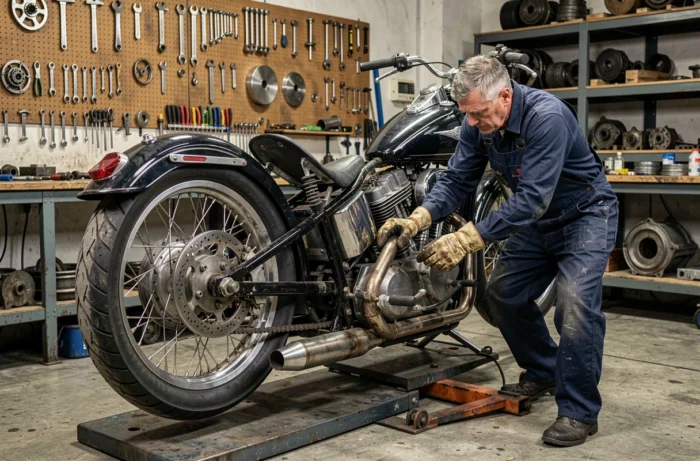
Transforming your motorcycle into a trike means changing machines. The chassis receives an additional rear (or front) axle, the braking system is rethought, and the registration document must be updated. The cost of this operation varies from simple to triple depending on the type of kit, the starting motorcycle, and the desired level of finish. Here are the budget items to anticipate and the pitfalls to avoid.
What drives the cost beyond the trike kit
When discussing the cost of a trike transformation, the first reflex is to look at the price of the kit. Entry-level kits start at under 3,000 euros, while custom builds can exceed 10,000 euros. But this range tells only part of the story.
The items that inflate the bill are often absent from the initial quote. Reinforcing the frame and adapting the braking system represent significant work, charged by hours of labor in the workshop. On a Honda Gold Wing GL 1800 or a Harley Davidson Road Glide, the structure must withstand mechanical stresses very different from those of a two-wheeler.
Additionally, there is an item that many discover late: administrative compliance. In France, any significant modification of a vehicle requires a single vehicle approval (RTI) issued by the DREAL. The indicative cost of this RTI is 86.90 euros in Nouvelle-Aquitaine, but the real cost lies in the time spent preparing the technical file and the back-and-forth with the administration.
To accurately estimate the price of transforming a motorcycle into a trike, you must therefore add the kit, labor, reinforcement parts, the RTI, and the update of the registration document.
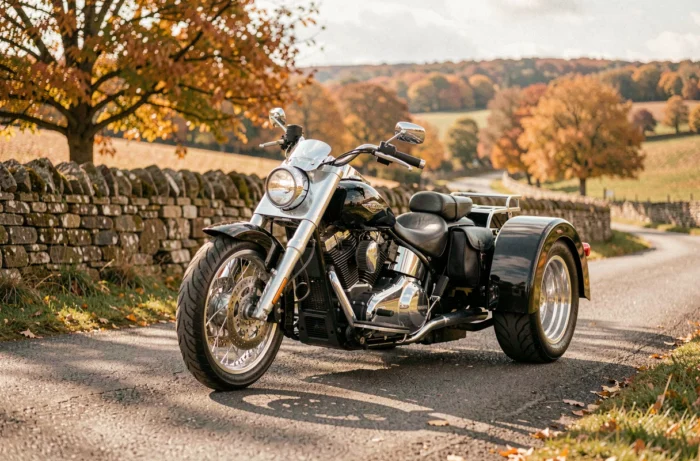
Starting motorcycle and conversion kit: combinations that change the budget
Not all motorcycles lend themselves equally well to conversion. Do you have a Gold Wing 1800? It is the most documented model, with kits offered by brands like Hannigan or Motor Trike. Parts are available, workshops know the machine, and the assembly time is relatively predictable.
On a Harley Davidson (Electra Glide, Road King, Street Glide), the transformation is just as common. However, medium-displacement motorcycles or rare models extend the timelines and budget, as the kit requires specific adaptations that the workshop charges on a case-by-case basis.
Universal kit or model-specific kit
A kit designed for a specific model installs faster and requires fewer modifications to the frame. A so-called “universal” kit is cheaper to purchase, but labor costs rise: custom welds, mounting brackets to be made, longer alignment adjustments.
Why does this choice matter so much? Because the labor of a specialized workshop in France often represents half of the total budget. Choosing a kit suited to your motorcycle limits workshop hours.
- Dedicated kit (Gold Wing, Harley touring): faster assembly, verified compatibility, spare parts available from the manufacturer.
- Universal kit: lower purchase price, but significant mechanical adaptations, extended timelines, and frequent labor cost overruns.
- Complete custom transformation: the most expensive, reserved for motorcycles for which no standard kit exists. Each part is made individually.
Homologation and taxation of the trike: costs after transformation
Once the assembly is complete, the motorcycle turned trike cannot hit the road without formalities. The RTI requires presenting the transformed vehicle to the DREAL, along with a complete technical file (plans, resistance calculations, workshop certificate).
Delays often exceed three months between the submission of the file and the receipt of the certificate. Good news for future projects: some DREALs, like that of Nouvelle-Aquitaine, plan to digitize the process via the OCTAVE2 platform starting in October 2026. This should reduce processing time, but not the cost.
Annual tax and insurance: the recurring budget
The change of category on the registration document has fiscal consequences. A documented case in Germany on a Honda GL 1800 shows that the annual tax increases from about 136 euros (motorcycle) to 400 euros (trike), resulting in more than 260 euros of additional cost per year. The logic is similar in France: the vehicle changes administrative category, and the tax power is recalculated.
On the insurance side, a trike falls into a different category than the original motorcycle. Not all specialized two-wheeler insurers cover trikes. Sometimes, you need to turn to specific contracts, with premiums higher than a standard motorcycle insurance.
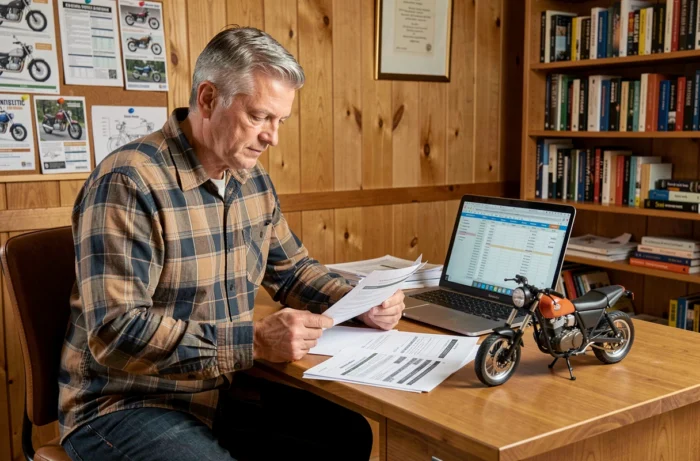
Checklist before signing a trike transformation quote
A serious quote does not just include a line “kit + installation.” Before committing, check that the following items are detailed or at least mentioned.
- The cost of the kit, the brand, and the exact reference, as well as its compatibility with your motorcycle model.
- The estimated labor in hours, including frame reinforcement, braking adaptation, and rear (or front) suspension adjustment.
- The handling or not of the RTI file by the workshop, and the associated administrative fees (RTI, new registration document).
- Realistic timelines: between ordering the kit, assembly, and homologation, expect several months at a minimum.
- The warranty on the assembly and installed parts, a point rarely addressed but which can avoid significant costs in case of issues.
Request at least two detailed quotes from different workshops. Price differences between transformers in France are significant, and a more expensive quote may include items that the other overlooks. The cheapest is not always the most economical once the project is completed.
One last point to keep in mind: the manufacturer’s warranty on your motorcycle is generally voided once the transformation occurs. If your machine is recent, wait until the warranty period ends before starting the project.