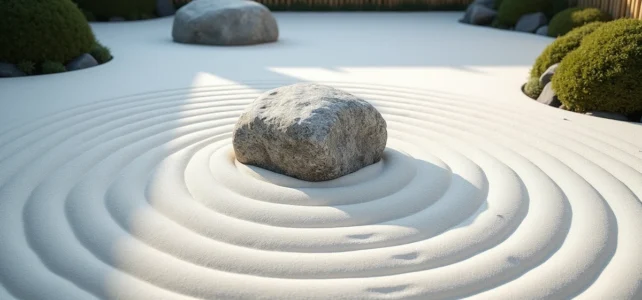
The sand of a zen garden is not just a simple flooring material. It is a contemplative surface intended for raking, which imposes radically different selection criteria than those for a pedestrian walkway or a laying bed for paving. Choosing suitable sand for a Japanese zen garden requires thinking in terms of grain size, mineral composition, and behavior against the elements, rather than in terms of compaction or load-bearing.
Contemplative surface and walkable surface: two opposing specifications
The majority of available guides treat zen garden gravel with the same criteria as walkway gravel. However, we observe that the constraints are reversed.
A walkway gravel must compact, resist puncturing, and remain stable underfoot. In contrast, karesansui gravel (dry garden) must remain loose to allow the rake to pass while maintaining the sharpness of the grooves drawn for several days.
Specifically, a material that is too angular interlocks and resists the rake. A material that is too round (rolled pebble) does not retain patterns. The compromise lies in crushed aggregates with slightly rounded edges, sometimes referred to as “semi-crushed,” which slide under the rake’s teeth without clumping. To better understand the available options, consult this guide on suitable sand for Japanese zen gardens.
Grain size and pattern retention
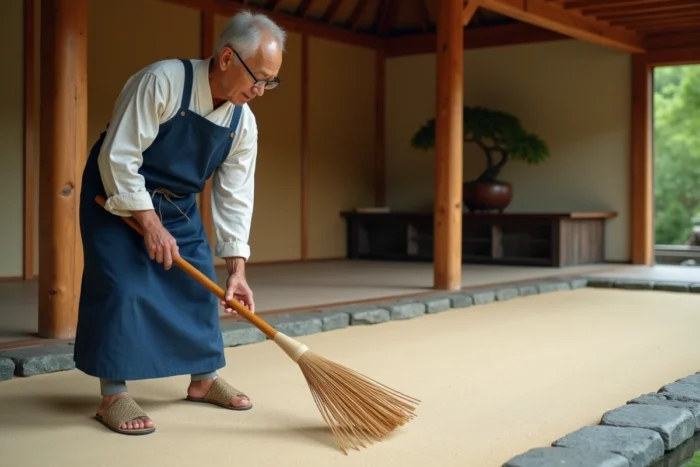
We recommend a range of grain size between 2 and 8 mm for comfortable raking. Below 2 mm, the sand disperses at the slightest gust of wind and quickly clogs with organic debris. Above 10 mm, the grooves lose their finesse and the appearance resembles more of a mineral mulch than a sea of sand.
Intermediate grain sizes (4/8 or 6/10 according to French commercial designations) offer the best balance between pattern readability and resistance to wind dispersion.
Adapting zen garden sand to local climatic constraints
Consumer articles recommend “white sand” or “light gravel” without ever linking this choice to the climate of the installation area. This is a major oversight, as wind, frost, and heavy rains directly condition the type of viable material.
Windy and coastal areas
By the sea or in windy corridors (Rhône Valley, Breton coasts), fine white silica sand will be partially carried away with each episode of mistral or west wind. Increasing the grain size (minimum 6/10) and favoring crushed marble aggregate, denser than limestone, reduces material loss.
Regions with frequent frost
Some frost-sensitive limestones disintegrate after a few freeze/thaw cycles, producing a fine whitish powder that clogs the grooves and gives a muddy appearance during thawing. Granite, basalt, or marble aggregates resist temperature fluctuations much better.
Episodes of heavy rain
On poorly drained ground, a heavy downpour transforms the raked surface into a muddy basin. Two technical precautions:
- Lay a geotextile under the gravel layer to prevent clay soil from rising while allowing water to infiltrate.
- Ensure a sufficient thickness of gravel (at least three to four times the grain size) so that the layer retains its structure after runoff.
- Create a slight peripheral slope to drain excess water towards a planted area or a drainage pit.
Mineral composition of sand: silica, marble, or granite
The choice of mineral is not just aesthetic. It determines durability, color over time, and, for large-scale projects, handling precautions.
White silica sand offers the brightest hue, close to the historical karesansui of Kyoto. However, respirable crystalline silica is increasingly subject to regulatory oversight in the European Union for professional exposure. In a small hand-raked domestic garden, the risk remains limited, but for large-scale landscaping projects, this health constraint is pushing more professionals towards alternatives.
Crushed white marble is the most common alternative. Its whiteness is slightly warmer than that of silica, it does not generate crystalline silica dust, and it withstands frost reasonably well in most French regions. Its intermediate hardness allows for smooth raking.
Crushed granite (light gray, beige, or pink) is suitable for zen gardens that do not seek pure white. Its mechanical resistance and frost durability make it a relevant choice in mountainous regions or exposed areas.
Maintenance of zen garden sand: actions that prolong the surface
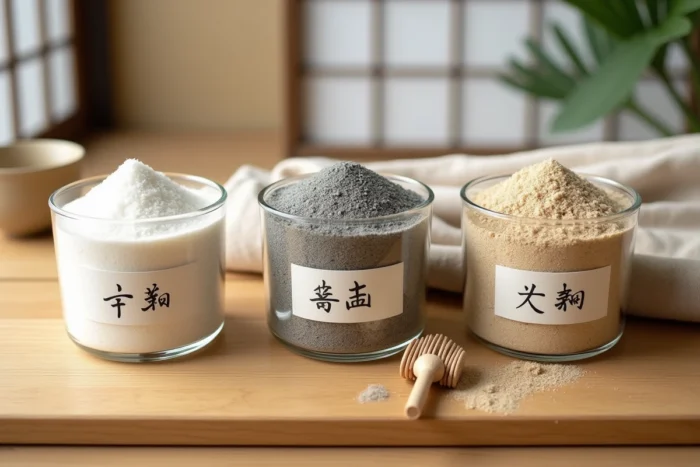
A karesansui requires regular but simple maintenance, provided the material has been properly chosen in advance.
- Rake after each rainy episode to restore patterns and check that the geotextile is not surfacing.
- Remove dead leaves and plant debris at least once a week in autumn, as their decomposition irreversibly stains the light gravel.
- Top up the gravel layer once a year if wind dispersion or runoff has reduced the thickness below the critical threshold.
- Avoid any chemical herbicide treatment directly on the gravel: a properly laid geotextile is sufficient to block most weeds.
A well-chosen gravel according to the local climate requires little renewal, whereas unsuitable sand necessitates frequent and costly top-ups.
The Japanese dry garden rests on a paradox: its visual simplicity demands technical rigor in advance. Grain size, mineral nature, drainage, and wind exposure form an interdependent system. Neglecting any one of these parameters transforms the meditative surface into a permanent maintenance chore.