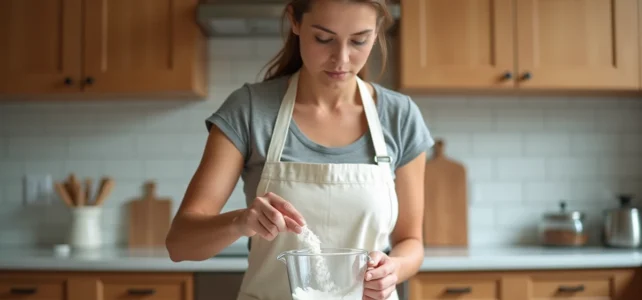
We follow a recipe, grab a bag of flour, and the instructions indicate a volume in liters while the packaging shows grams. The reflex to divide by a thousand only works for water. For all other ingredients, this approximation skews the measurement, sometimes visibly in the plate or mold.
Why grams and liters do not measure the same thing
Grams quantify mass. Liters quantify volume. Between the two, there is density, specific to each substance. Without it, we are comparing two quantities that have no direct link.
The formula can be summed up in one line: volume in liters = mass in grams divided by density in g/mL, then divided by 1000. For water, the density is around 1 g/mL, so 1000 grams give 1 liter. You can convert grams to liters on Agir Emploi by following this same principle applied to different common ingredients.
As soon as we move away from water, the discrepancies widen. Olive oil, being less dense, occupies more volume for the same mass. Flour, depending on whether it is packed or aerated, changes density within the same bag. Honey, significantly heavier than water at equal volume, traps those who measure with a measuring cup.

Density of common cooking ingredients: the true conversion benchmark
Knowing the density of an ingredient allows for confident conversion. Here are the most useful practical values for everyday use.
| Ingredient | Approximate density (g/mL) | Mass for 1 liter |
|---|---|---|
| Water | 1.00 | 1000 g |
| Whole milk | 1.03 | 1030 g |
| Vegetable oil | 0.92 | 920 g |
| Wheat flour (not packed) | 0.55 – 0.65 | 550 – 650 g |
| Granulated sugar | 0.85 | 850 g |
| Honey | 1.40 | 1400 g |
These values vary depending on temperature and the exact composition of the product. Organic whole milk and semi-skimmed milk do not have strictly the same density, although the difference remains small for culinary use.
The trap of flour and powders
Flour illustrates the problem best. The same bag of flour changes density depending on whether it is shaken, packed, or poured. A measuring cup filled to the brim after packing can contain significantly more grams than a cup filled by sprinkling.
For baking, where precision matters, the scale remains the reliable tool. The measuring cup is suitable for homogeneous liquids (water, milk, oil), not for powders whose volume fluctuates with each handling.
Converting grams to liters without a scale: practical methods
You don’t always have a scale on hand. Here are some concrete references that can help.
- A standard table glass holds about 20 to 25 cl. For water, this corresponds roughly to 200-250 g. For oil, count slightly less in mass for the same volume.
- A level tablespoon represents about 15 mL. In uncompressed flour, this corresponds to about ten grams, while for sugar, it approaches 12 to 13 g.
- A standard can (classic size) often contains around 400 mL. For a dense liquid like honey, the weight significantly exceeds that of water for the same container.
These references provide a rough estimate, not a laboratory measurement. Feedback varies on this point: some cooks achieve very consistent results with a measuring cup, while others notice notable discrepancies, especially with dry ingredients.
When the online converter really helps
Recent converters have an advantage over printed tables: they require selecting the ingredient before calculating. This mandatory step prevents the classic error of applying water’s density to everything. Some tools even incorporate the temperature of the liquid into the calculation, refining the result for technical or laboratory uses.
A converter that does not allow ingredient selection defaults to applying water’s density. In this case, the result is only reliable for water itself.

Common mistakes when converting grams to liters
The majority of conversion errors stem from three ingrained habits.
The first: applying the equivalence 1 g = 1 mL to all ingredients. This rule only holds true for water at room temperature. For oil, sugar, or flour, the gap between mass and volume is too large to ignore.
The second: neglecting the physical state of the ingredient. Melted butter and solid butter do not occupy the same volume for the same mass. A recipe that states “100 g of butter” does not require the same action as a recipe that states “10 cl of melted butter.”
The third: confusing volume units with one another. A deciliter is 100 mL, not 10. A centiliter is 10 mL. These confusions, combined with incorrect density, accumulate errors and can double or halve the actual quantity.
- Check the unit of the recipe (mL, cL, dL, L) before any conversion.
- Identify the ingredient and its density rather than applying a universal ratio.
- Weigh instead of measuring by volume whenever precision matters, especially in baking.
Mass, volume, and density: the formula to remember for converting grams to liters
All conversion relies on a simple principle. Volume (L) = Mass (g) / (Density in g/mL x 1000). In practice, you first divide grams by density to get milliliters, then divide by 1000 to convert to liters.
Let’s take a concrete case: you have 500 g of vegetable oil (density about 0.92 g/mL). You divide 500 by 0.92, which gives about 543 mL, or roughly 0.54 liters. With water, 500 g would give exactly 0.5 liters. The difference seems modest, but with large quantities (a 5-liter can, a whole bag of flour), it becomes significant.
For everyday ingredients, just keeping in mind the density of the five or six products you use most is enough. The scale remains the most reliable tool to avoid relying on an approximate conversion. When the recipe mixes grams and centiliters, converting everything to grams before starting avoids back-and-forth between mass and volume.