The comfort of a home relies on a principle that is often underestimated: the management of thermal flows. Before investing in active equipment like air conditioning, the first lever is to prevent heat from entering in summer and to retain it in winter. This passive approach combines insulation, solar protection, and ventilation to reduce dependence on energy-intensive systems.
Optimizing the comfort of your home step by step requires understanding these mechanisms before choosing innovative solutions tailored to each aspect.
External solar protection: the most underestimated aspect of thermal comfort
A curtain or blind placed inside a window blocks light, but not heat. Solar radiation has already passed through the glazing and warms the indoor air. External solar protection stops the radiation before it reaches the glazing, which radically changes the effectiveness of the system.
Roller shutters, adjustable sunshades, and vertical projection blinds are fixed to the facade or window frame. Their external position blocks the majority of solar thermal flow before it reaches the glass. This distinction between interior and exterior protection changes the priority order of investments: a good external sunshade is preferable to an oversized air conditioning system.
Vegetative shading complements this strategy. A deciduous tree planted on the south or southwest side filters the sun in summer and allows light to pass through in winter. This long-term, cost-free solution requires a few years of growth but offers sustainable comfort without energy consumption.
To delve deeper into this progressive approach, the maisonluminea fr guide on Technique Habitat details the steps to follow based on the type of housing.

Thermal insulation of walls and floors: where to focus the work
Insulation is not limited to attics. Walls, floors, and joinery all contribute to thermal losses, but their relative weight varies depending on the building’s configuration.
Roof and attic as a priority
Warm air rises. In winter, a poorly insulated roof allows heat produced by heating to escape. In summer, an uninsulated attic turns the floor above into an oven. Addressing the roof remains the action with the best cost-effectiveness ratio in most single-family homes.
Walls and floors: completing the envelope
External insulation eliminates thermal bridges at wall-floor and wall-roof junctions. This technique wraps the building without reducing the living space. Floor insulation, often overlooked, limits the sensation of cold on contact and stabilizes the indoor temperature thanks to the thermal inertia of the slab.
The choice of material (mineral wool, wood fiber, cellulose wadding) depends on the area being treated and the budget. Wood fiber, for example, offers good thermal lag: it slows the penetration of summer heat through the wall, maintaining a stable indoor temperature for longer.
Ventilation and management of indoor air flows
A well-insulated but poorly ventilated house accumulates humidity and pollutants. Controlled mechanical ventilation (CMV) renews the air without opening windows, which prevents hot air from entering during the day.
- The double-flow CMV recovers heat from the extracted air to preheat incoming air in winter and can cool fresh air in summer if it includes an efficient heat exchanger.
- Night-time over-ventilation involves widely opening windows at night to expel heat stored in the walls and floor during the day. This principle exploits the thermal inertia of the building.
- Cross-ventilation, achieved by opening windows on two opposite facades, creates a natural airflow more effective than a simple mechanical fan.
Adjusting ventilation times to the outside temperature is part of the free high-impact actions. Closing windows as soon as the outside air exceeds the indoor temperature prevents the home from passively warming up.

Control of internal heat sources and home automation
Thermal comfort does not solely depend on the building’s envelope. Appliances, lighting, water heaters, and standby equipment continuously emit heat. Reducing these internal contributions complements insulation work.
Some concrete levers:
- Shifting the use of the oven and washing machine to the coolest hours reduces the rise in indoor temperature during heat peaks.
- Replacing remaining halogen bulbs with LEDs decreases both energy consumption and thermal output.
- Turning off standby devices (internet box, decoder, console) eliminates diffuse but cumulative heat sources throughout the day.
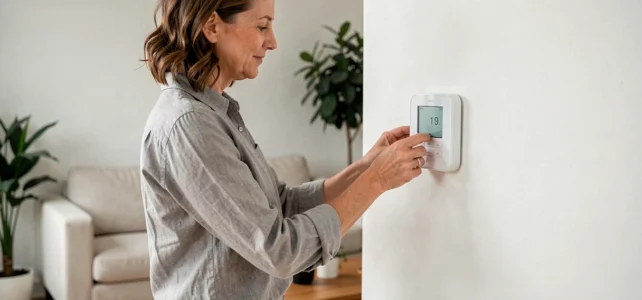
Connected systems allow for precise control of temperature room by room. A programmable thermostat combined with presence sensors adjusts heating or cooling based on actual occupancy. This regulation prevents heating or cooling empty rooms, reducing energy bills without sacrificing comfort.
Regular measurement of indoor temperature and humidity, using a simple thermometer-hygrometer or a connected sensor, provides an objective basis for adjusting habits. Many homes are overheated in winter due to a lack of feedback on actual conditions.
Optimizing the comfort of a home does not rely on a single spectacular action. It is the combination of a high-performing envelope, controlled ventilation, and careful management of usage that produces a lasting result. External solar protection remains the first aspect to address before any expenditure on active equipment, and behavioral adjustments, often free, complement the whole without additional cost.