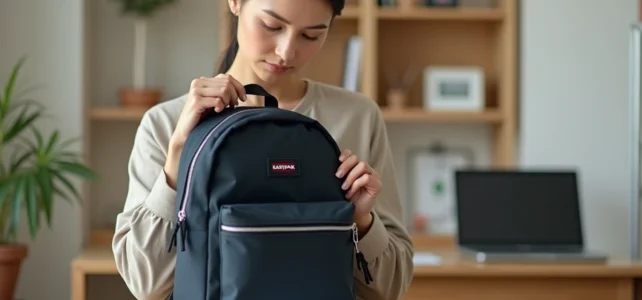
Distinguishing a genuine Eastpak bag from a counterfeit is not limited to flipping the product to inspect a label. The problem has shifted: beyond crude copies, marketplaces are filled with products sold by third parties whose reliability varies greatly. Even before touching the bag, verification starts with the purchasing channel.
Eastpak Counterfeit: Third-Party Seller or Physical Product, Where Does the Risk Lie
| Criterion | Purchase at Official Store or Eastpak Site | Purchase via Third-Party Seller (Marketplace) |
|---|---|---|
| Manufacturer’s Warranty | Limited warranty up to 30 years depending on the model | Often absent or not honored |
| Product Sheet | Exact model reference, dimensions, material | Information may be vague or incomplete |
| Photos | Official high-resolution visuals | Generic or borrowed photos |
| Seller Identity | Eastpak directly or identified authorized reseller | Recent profile, few reviews, unclear terms |
| Return Policy | Return within 30 days, clear procedure | Variable, sometimes at the buyer’s expense |
| Counterfeit Risk | Almost none | Significant if the seller is not verified |
Recent buying guides emphasize a point that most video tutorials overlook: check the seller before checking the bag. An abnormally low price should raise alarms, but it is not enough to conclude. One must cross-check the seller’s identity, the quality of the photos, the presence of a precise product reference, and detailed reviews before placing an order.
To reliably verify the authenticity of an Eastpak, starting with the distribution channel allows for the elimination of most risks without even having the bag in hand.
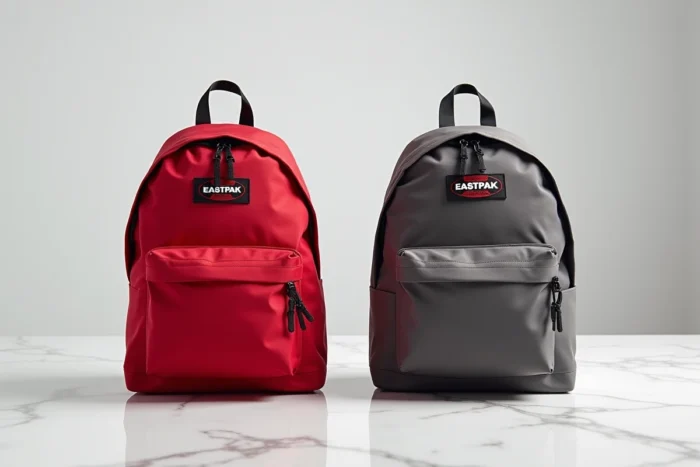
Logo, Stitching, and Zippers: The Physical Details of an Authentic Eastpak
Once the bag is in hand, several physical elements allow for a decision. Eastpak states on its official page that all its products are made according to high-quality standards, and any anomaly in materials or manufacturing should raise suspicions.
The Embroidered or Printed Logo
On a genuine Eastpak, the logo is sharp, centered, and consistent. The letters are evenly spaced. On a counterfeit, one often observes a slightly misaligned logo, loose threads, or approximate typography.
Quality of Stitching
The stitching of a genuine Eastpak is regular and reinforced at stress points (straps, bottom of the bag, top handle). An irregular thread, skipped stitches, or fabric that wrinkles along the seams indicate a lower quality product.
The Zippers
Eastpak uses zippers that glide smoothly. The slider has a noticeable weight in hand. On counterfeits, the slider is often lighter, the pull tab poorly attached, and the zipper resists or derails during use.
- Test the smoothness of the zipper along its entire length, back and forth, paying attention to the corner points
- Check that the slider has a readable inscription and that the metal finish is uniform
- Observe the alignment of the teeth: on an original, they are perfectly regular and show no misalignment
Inner Label and Product Reference: The Least Forgery-Prone Proof
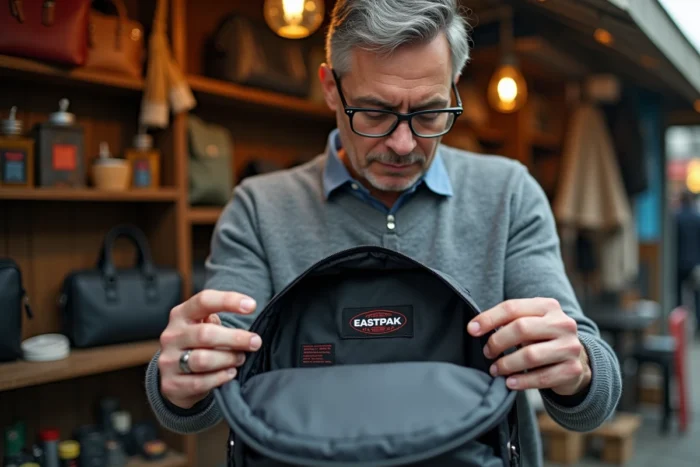
The inner label is one of the most difficult elements to reproduce faithfully. It contains the model reference, the fabric composition (often polyester), the country of manufacture, and sometimes a specific code.
On a genuine Eastpak, this label is neatly sewn, with text printed without smudging. The reference corresponds to the model as it appears on the brand’s official website. In case of doubt, comparing this reference with the online catalog allows for quick confirmation or denial of authenticity.
A counterfeit often has a glued label rather than a sewn one, with thicker typography or errors in the indicated composition. Some copies completely omit the reference code.
Eastpak Hologram and Warranty: Two Complementary Markers
Eastpak mentions on its site the presence of a security hologram on its products. This holographic sticker, difficult to reproduce accurately, changes reflection depending on the angle of view. On counterfeits, the hologram is often static, dull, or simply absent.
The warranty is another reliable marker. Eastpak offers a limited warranty that can last up to 30 years on certain models. This warranty does not cover counterfeit products. Attempting to claim the warranty from Eastpak allows for indirect verification of the product’s authenticity: if the brand refuses coverage citing an unlisted product, the counterfeit is confirmed.
Inspired Products and Legal Copies: A Blind Spot in Verification
The risk is not limited to fakes bearing the Eastpak logo. Some bags sold in retail or on marketplaces replicate the brand’s visual codes (shape, pocket arrangement, colors) without carrying the Eastpak name. These products are not technically counterfeits, but they deceive buyers who think they are acquiring a product of equivalent quality.
- A bag very similar to a popular Eastpak model, sold without brand mention, offers neither the same fabric strength nor the same durability of zippers
- The absence of a manufacturer’s warranty is the first signal: Eastpak guarantees its products, inspired copies do not
- The textile composition differs: Eastpak uses dense, durable polyester, while imitations opt for a lighter weight
The difference between an inspired copy and an Eastpak is measured by use. The polyester of an original Eastpak retains its shape and color much longer than a generic fabric. This is not visible at the time of purchase, making the verification of the brand and the seller all the more crucial at the time of ordering.