
Spanish is the second most spoken native language in the world, just behind Mandarin. However, knowing where this language is actually used on a daily basis is not just about listing countries. The terms “Spanish-speaking” and “Latino” cover very different realities, and confusing them leads to misleading shortcuts.
Before detailing the geographical areas, a clarification of vocabulary is necessary. Spanish-speaking refers to any person or country whose primary language is Spanish. The word “Latino,” on the other hand, refers to a geographical and cultural origin linked to Latin America, without necessarily implying the use of Spanish. A Brazilian is Latino, but he speaks Portuguese. A Spaniard is Spanish-speaking, but no one refers to him as Latino. Understanding in which countries Spanish is spoken first requires separating these two concepts.
Spanish as an official language: the map doesn’t tell the whole story
Spanish has official or co-official status in about twenty countries. The majority are located in Latin America: Mexico, Colombia, Argentina, Peru, Venezuela, Chile, Ecuador, Guatemala, Cuba, Bolivia, Honduras, Paraguay, El Salvador, Nicaragua, Costa Rica, Panama, Uruguay, Dominican Republic. In Europe, Spain. In Africa, Equatorial Guinea.
But “official language” does not mean “language spoken by all.” In Paraguay, for example, Guarani is co-official and widely used in daily life. In Bolivia, the Constitution recognizes dozens of indigenous languages alongside Spanish. The official status indicates a political choice, not always a uniform linguistic reality.

In Equatorial Guinea, the only sub-Saharan African country where Spanish is official, the language coexists with French, Portuguese, and several Bantu languages. The daily use of Spanish there varies greatly by region and generation.
Spanish in the United States: a case without official status
Have you noticed that in the United States, signs, administrative forms, and telephone services systematically offer an option in Spanish? This is not by chance. About one in five residents uses Spanish as their primary language at home, according to recent data. This figure places the United States among the largest Spanish-speaking areas on the planet, surpassing Spain itself in terms of the sheer number of speakers.
Spanish has no federal official status there. No national law grants it any special recognition. It is a widely spoken language, driven by decades of immigration from Mexico, Puerto Rico, Cuba, El Salvador, and Colombia.
This case illustrates the limitation of traditional lists of “Spanish-speaking countries.” A country without official status can have more speakers than a country where Spanish is enshrined in the Constitution. The geography of Spanish is not solely reflected in legal texts.
Africa and the Philippines: two opposing trajectories for the Spanish language
The Philippines were under Spanish administration for over three centuries. Spanish was an official language until the enactment of the 1986 Constitution. Since then, it has lost all legal status. There are still Spanish-derived words in Tagalog (the days of the week, for example), but the active use of Spanish is marginal.
In Africa, the dynamic is the opposite. Several English-speaking and French-speaking countries on the continent are incorporating Spanish into their educational curricula. Sub-Saharan Africa is a new front for the spread of Spanish, with a growing number of learners in formal training. This phenomenon is not based on a colonial legacy, but on a strategic choice related to trade and diplomacy with Latin America.
What these two examples reveal
The historical presence of a language does not guarantee its survival. And the absence of a colonial heritage does not prevent voluntary adoption. The map of Spanish in the world is being redrawn based on economic and educational factors, not solely historical ones.
Spanish-speaking, Latino, Castilian: vocabulary that causes confusion
Let’s revisit these terms that are often mixed up, with concrete examples:
- Spanish-speaking: a Mexican, a Spaniard, an Ecuadorian. The criterion is the spoken language, Spanish, regardless of the continent.
- Latino or Latin American: a Brazilian, an Argentine, a Haitian. The criterion is geographical and cultural, linked to Latin America. A Brazilian is Latino but Portuguese-speaking, not Spanish-speaking.
- Castilian: a term used in Spain to distinguish Spanish from other languages of the country (Catalan, Basque, Galician). “Castilian” and “Spanish” refer to the same language. In Latin America, people almost always say “Spanish” or “español.”
In Spain, the 1978 Constitution recognized the autonomous communities’ right to assert their own languages. Catalan is official in Catalonia, Basque in the Basque Country, Galician in Galicia. Spanish (Castilian) remains the official language of the state, but Spain is a multilingual country where Spanish coexists with several other languages.
Spanish from Spain and Spanish from Latin America: one language, different usages
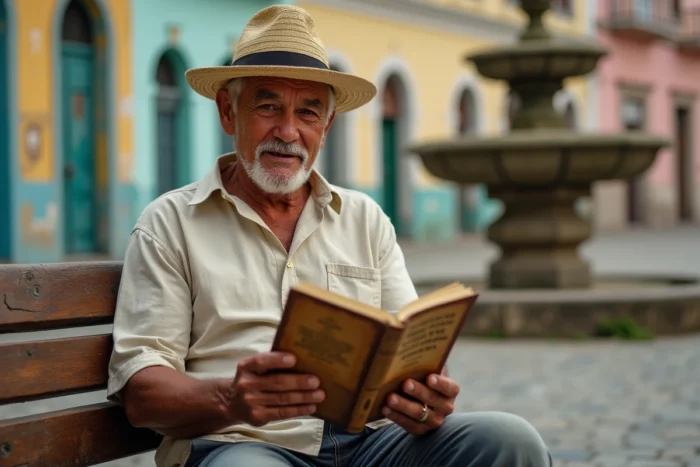
A Spanish speaker from Madrid and a Spanish speaker from Bogota understand each other without difficulty. The differences lie in specific vocabulary, pronunciation, and grammar points, comparable to those between French from France and French from Quebec.
Two telling examples:
- The pronoun “vosotros” (you, plural informal) is common in Spain but almost absent in Latin America, where “ustedes” is used in all registers.
- The “voseo,” that is, the use of “vos” instead of “tú” to say “you,” is widespread in Argentina, Uruguay, and some regions of Central America. It is unknown in Spain.
Everyday vocabulary also diverges. A car is called “coche” in Spain, “carro” in Colombia, “auto” in Argentina. These variations do not hinder mutual understanding, but they surprise learners who discover Spanish through a single country.
Spain today houses less than one-tenth of the world’s Spanish speakers. The 2024 report from the Instituto Cervantes confirms that the growth of Spanish is driven by Latin America and the United States, not by the Iberian Peninsula. Learning Spanish in 2025 means accessing a linguistic space spread across four continents, with regional variations that enrich the language without fragmenting it.