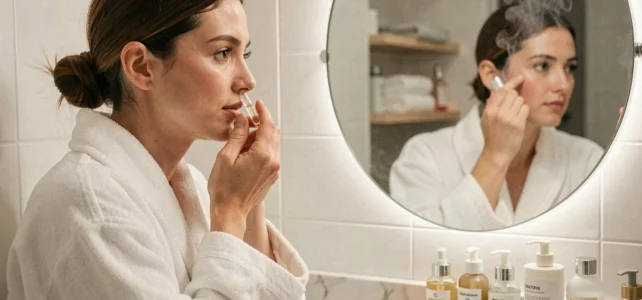
A beauty routine is not measured by the number of products lined up on the bathroom shelf. It is defined by the alignment between each action and the actual needs of the skin at a given moment. For a few seasons now, the dominant trend in facial care has shifted away from ten-step protocols towards a shorter, more targeted approach, often summarized by the term skinimalism.
Over-routine beauty: when too many products damage the skin
Layering a cleanser, toner, vitamin C serum, a second hyaluronic acid serum, a moisturizer, an eye cream, and SPF every morning seems like a complete program. In practice, this accumulation often creates more problems than it solves.
The stacking of active formulas continuously stresses the skin barrier. Using two exfoliants in the same week (a mechanical scrub on Tuesday, an AHA serum on Friday) can cause redness, tightness, or gradual sensitivity. The skin is not lacking care; it is lacking respite.
Duplicate products are the first items to eliminate. A hydrating serum followed by a moisturizer with the same actives does not provide anything more than one of the two, properly dosed. Before adding a product, the useful question is simple: what specific problem does this action solve, and does an already present product in the routine not cover it?
Several specialized contents recently published on the beauty section of Chroniques Blondes detail this sorting logic applied to facial and body routines, with concrete tips for identifying the truly useful steps.
Skin barrier and facial care: understand before applying
The skin barrier refers to the outermost layer of the epidermis, composed of lipids and dead cells bound together. Its role is twofold: to retain water inside the skin and to prevent irritants from entering.
When this barrier is weakened, the signs are recognizable: skin that feels tight after cleansing, diffuse redness, a tingling sensation when coming into contact with a product that is usually well tolerated. “Barrier-repair” formulations are gaining ground in 2026 precisely because many routines from previous years, heavily focused on exfoliation and powerful actives, have damaged this protective layer.
Gentle actives and multifunctional formulas
The refocusing is around a few well-tolerated actives. Ceramides, squalane, and hyaluronic acid are returning in the majority of facial cream formulas designed to restore the barrier. The interest of multifunctional products lies here: a single cream that hydrates and protects replaces two or three bottles.
Reducing the number of steps does not mean reducing effectiveness. It means that each remaining product in the routine must justify its place with a measurable benefit for the skin.
Morning and evening facial routine: the steps that really matter
Cleansing remains the fundamental gesture, morning and evening. In the morning, a gentle cleanser is enough to remove the sebum produced overnight. In the evening, a more thorough cleansing eliminates residues of pollution, makeup, and sunscreen.
After cleansing, the minimal effective sequence consists of two actions:
- A serum or moisturizer suitable for the skin type (oily, dry, combination, sensitive), applied on slightly damp skin to promote absorption
- Sun protection in the morning, even on cloudy days, as UV rays remain the primary cause of premature skin aging
- In the evening, replace the SPF with a repairing treatment or a serum targeted at a specific concern (spots, enlarged pores, wrinkles), without layering multiple products
Three steps in the morning, two in the evening: this foundation covers the needs of the vast majority of skin types. Any additional addition must address an identified need, not a desire to complete a collection.

Personalizing care: adapting your routine to your skin, not to trends
Standardized routines pose a fundamental problem: they ignore that two combination skins do not react the same way to the same serum. Personalization, which is emerging as a fundamental trend, does not necessarily require sophisticated algorithmic diagnostics.
It begins with careful observation. Skin that shines in the T-zone but feels tight on the cheeks does not require the same care everywhere. Applying a rich cream all over the face out of habit ignores this signal. Adapting the texture and concentration zone by zone yields better results than a single product applied everywhere.
Makeup as an extension of care
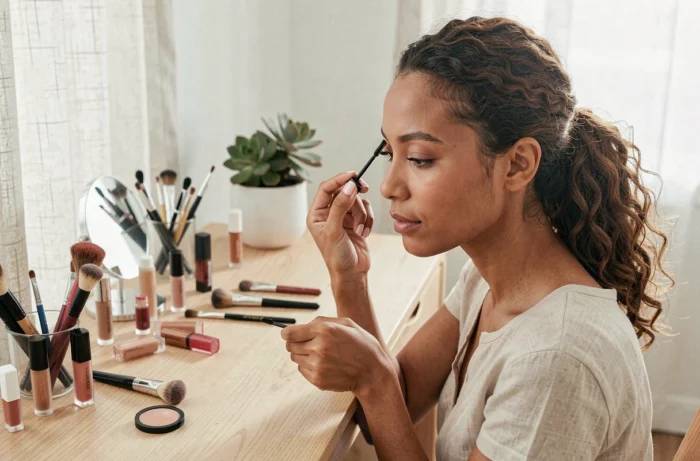
The “skin-first” makeup trend extends this logic. Recent foundations and primers incorporate hydrating or soothing actives, with natural and luminous finishes rather than heavy coverage. The idea is no longer to mask the skin but to show it in a better state.
This shift also changes makeup removal. Light makeup can be removed with a gentle cleanser, without the need for an aggressive double cleanse. Fewer layers applied in the morning, less friction in the evening: the virtuous circle works both ways.
Signs of skin irritation: recognizing an unsuitable routine
Some signals should alert you that the current routine is doing more harm than good:
- Persistent redness that appeared after introducing a new product, which does not disappear within two weeks
- A systematic feeling of tightness after cleansing, a sign that the cleanser is too stripping or that the skin is over-exfoliated
- Localized breakouts in areas where multiple products overlap (chin, forehead), sometimes linked to excessive occlusion
- Skin that “drinks” the cream instantly without ever seeming hydrated, a classic indicator of a damaged skin barrier
In response to these signs, the most effective solution is not to add another repairing treatment. It is to temporarily remove all actives (exfoliants, retinol, vitamin C) and revert to the trio of gentle cleanser, basic moisturizer, and sun protection for a few weeks.
The skin has its own regeneration capacity that works better when we stop hindering it. The most underestimated gesture in a beauty routine remains that of applying nothing more.