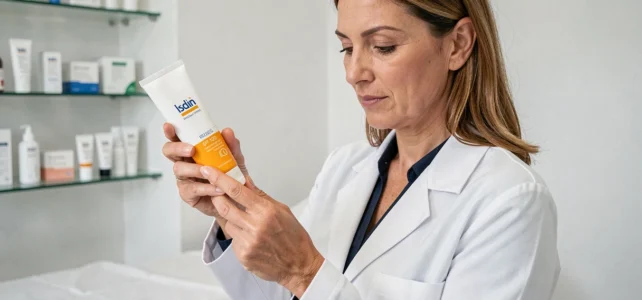
The Isdin 100 range is based on an uncommon positioning in the photoprotector market: a displayed SPF of 100+, combined with active ingredients aimed at preventing actinic damage and correcting dyschromias. For dermatologists, this combination is not just about a high index on the packaging. It raises specific questions about actual spectral protection, formulation, and usage conditions that justify (or not) the use of such a product.
Sun Filters and Spectral Coverage of the Isdin 100 Range
The technical uniqueness of the Isdin 100 references lies in their combination of organic and mineral filters covering a broad spectrum, including UVB, long UVA, and short UVA. This filtering architecture goes beyond simply raising the SPF, which only measures UVB protection.
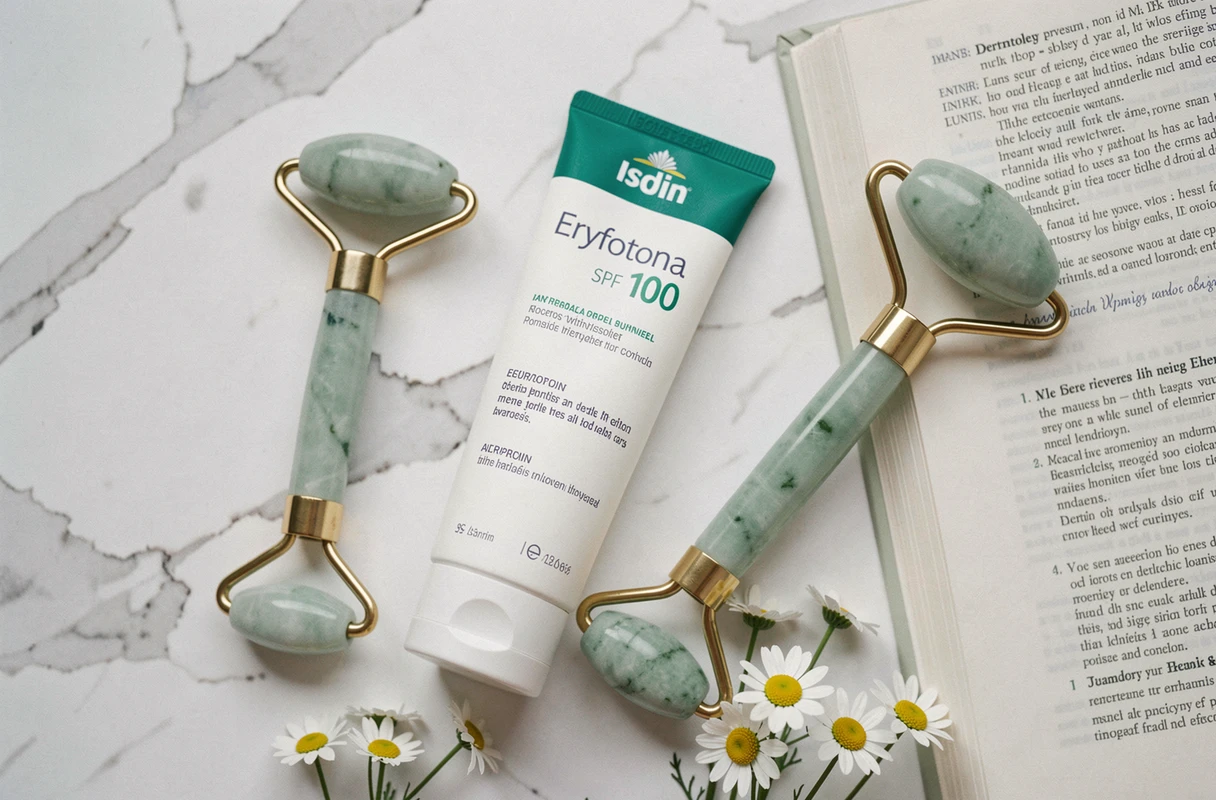
The Eryfotona AK Fluid SPF 100+ reference notably includes photolyase encapsulated in liposomes, a biological DNA repair enzyme. Its role: to act on the thymine dimers formed after UV exposure. This mechanism, documented in photobiology, positions the product beyond a mere passive screen.
Dermatologists who formulate a dermatologist opinion on Isdin 100 emphasize that photolyase does not replace the mechanical protection of the filter, but provides a complementary repair layer useful in interventional dermatology, particularly after laser or photodynamic therapy.
On the Foto Ultra 100 Spot Prevent, the filtering strategy targets visible light (HEV) more, which is involved in the worsening of melasma. Here we observe a rare segmentation: Isdin does not offer a single SPF 100, but several formulas tailored to distinct dermatological indications.
Texture and Compliance: What Dermatologists Evaluate in Clinical Practice
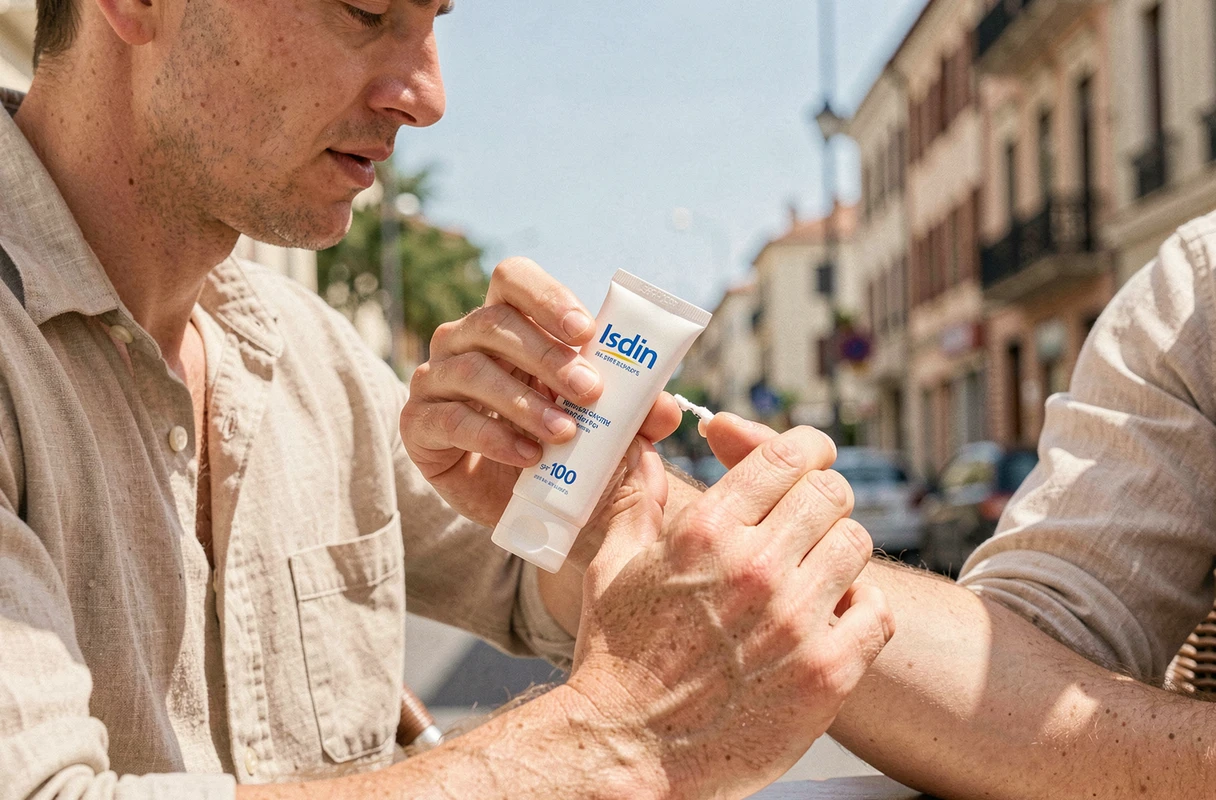
A high SPF is only valuable if the patient applies a sufficient amount and reapplies regularly. This is where the formulation of Isdin 100 attracts attention during consultations.
Fluid formats like Fusion Fluid facilitate the application of a uniform layer, whereas thick creams with high SPF often discourage daily use. The aqueous texture, almost invisible after application, removes the aesthetic barrier, especially on light phototypes prone to spots.
Dermatologists clearly value cream and fluid formats over sprays. The reason is simple: with a spray, the actual amount deposited on the skin remains unpredictable. Coverage is uneven, especially on the face. We systematically recommend the fluid for reliable daily photoprotection.
Application Quantity and Reapplication
The dermatological consensus requires about two milligrams of product per square centimeter of skin to achieve the stated SPF. In practice, most patients apply half of this dose. An under-dosed SPF 100 protects less than a properly applied SPF 50.
This is a point that consumer articles often overlook. The performance of Isdin 100 assumes generous application and reapplication every two hours in cases of prolonged exposure. The product does not create an absolute shield.
Targeted Dermatological Indications for Isdin 100
The clinical interest of an SPF 100+ does not concern the entire population. Dermatologists reserve it for specific profiles:
- Patients with actinic keratoses or a history of skin carcinoma, for whom the Eryfotona AK Fluid reference has been specifically developed with its photolyase-based repair complex.
- Post-dermatological procedures (fractional laser, medium peel, photodynamic therapy) where the skin, weakened and hypersensitive to UV, requires maximum protection for several weeks.
- Recalcitrant melasma, in addition to a depigmenting treatment, where protection against visible light in addition to UV reduces the risk of pigment rebound.
- Patients undergoing photosensitizing treatments (oral retinoids, certain antibiotics, immunosuppressants) for whom a standard SPF may prove insufficient under real application conditions.
Outside of these cases, a well-formulated and properly applied SPF 50+ meets the needs of the vast majority of patients. The 100 index does not double the protection compared to 50: the marginal difference in terms of percentage of blocked UVB remains low. The advantage lies in the safety margin it offers against chronic under-application.
Composition and Tolerance: Analysis of Isdin 100 Ingredients
Que Choisir classifies the Foto Ultra 100 Spot Prevent SPF 50+ without any identified undesirable ingredients in its comparative database. This reassuring positioning on composition does not exempt from careful examination for reactive skin.
The Isdin 100 formulas contain organic filters like octisalate or bis-ethylhexyloxyphenol methoxyphenyl triazine, combined according to the references. The absence of pure mineral filter (titanium dioxide, zinc oxide) in certain versions explains the light texture, but may raise questions for patients allergic to a specific chemical filter.
Tolerance on Sensitive and Reactive Skin
We observe good overall tolerance in consultations, including on post-procedural skin. The fragrance-free formulation of Eryfotona AK Fluid contributes to this compatibility. However, on atopic skin in flare or severe rosacea, a prior test on a limited area remains prudent before daily adoption.
Feedback on online parapharmacy platforms confirms this trend: the majority of users report no greasy sensation and good wear, two criteria directly correlated to long-term compliance.
Isdin 100 Compared to Classic SPF 50+ Photoprotectors
The recurring question in consultations remains: should one invest in an SPF 100 rather than a quality SPF 50+? The answer depends on the skin profile and exposure context.
- For daily urban photoprotection without any particular dermatological history, a properly applied SPF 50+ is sufficient.
- For the medical indications listed above, SPF 100+ offers a considerable safety margin, especially if the patient under-doses the application.
- The Isdin formulation (light fluids, non-greasy finish) represents a concrete advantage over thick competing creams that discourage regular use.
The additional cost of an SPF 100+ compared to a SPF 50+ of the same brand is clinically justified in situations of increased risk. For the rest, the regularity of application and the amount deposited matter more than the index printed on the tube.
The main contribution of Isdin 100 does not lie in its marketing figure, but in the architecture of its formulas: expanded spectral protection, repairing actives like photolyase, textures designed to maximize compliance. These parameters, far more than the displayed index, form the basis of dermatological recommendation.