Your neighbor sowed their grass in late March and achieved a green carpet in just a few weeks. You did the same, but the seeds barely germinated. The difference lies not in the calendar hanging in the garage, but in what happens beneath the surface of the soil. Knowing when to sow grass depends on an indicator that most guides overlook: the soil temperature, not the air temperature.
Soil Temperature and Grass Seed Germination
Take a kitchen thermometer and push it five centimeters into the ground. This number matters more than the weather of the day. The classic grasses of our gardens (ryegrass, fescue, bluegrass) belong to the “C3” grass family. Their optimal germination occurs when the soil stays between 15 and 24 °C.
Above 27 °C at soil level, the growth of these grasses slows down and then stops. In other words, sowing during the heat of June may leave the seeds stagnant for weeks, even if you water diligently.
It is the soil temperature that triggers germination, not the date. In practice, this favorable range occurs at two times of the year in France: in spring (April-May) and in autumn (September-October). The exact window varies depending on your region and the exposure of the land. To know precisely when to sow grass, you need to cross this temperature data with local humidity conditions.
Spring or Autumn Grass Sowing: What Results to Expect
Are you hesitating between the two windows? Here’s what distinguishes them concretely, beyond the simple “both work”.
Spring: Quick Germination, Demanding Follow-Up
Sowing in April or May allows you to take advantage of longer days and often still-present natural moisture. The seeds germinate quickly, sometimes within ten days.
The trap is what follows. A spring sowing faces its first summer without deep roots. If a heatwave hits in June, the young shoots suffer. Regular watering, sometimes daily, is then necessary to keep the surface soil cool.
Autumn: The Window Preferred by Professionals
In September, the soil retains the heat accumulated during the summer, while the nights become cool again and the rains return. Grass sown in autumn develops its roots for several months before winter. The following spring, it restarts with an already established root system, more resistant to summer drought.
The competition from weeds is also reduced in autumn. Many weeds finish their life cycle, leaving the field clear for the grasses you just sowed.
- Spring (April-May): quick germination, but young grass vulnerable to summer heat. Consistent watering is essential.
- Autumn (September-October): deep rooting before winter, fewer weeds, reduced watering needs thanks to natural rains.
- Summer (June-August): not recommended for classic C3 grasses. The soil often exceeds the favorable temperature limit.
Warm-Season Grasses: A Shifted Sowing Window
Do you have a garden in the south of France, sandy and draining soil, and your classic lawns burn every summer? There is an alternative still little known in general guides.
The so-called “C4” grasses, particularly improved Cynodon dactylon (sometimes called Bermuda grass), operate in contrast to classic grasses. Their optimal growth occurs between 25 and 38 °C. Their ideal sowing window falls at the end of May or even early June, when the soil is well warmed.
Documented feedback in a Mediterranean climate shows that sowing improved Cynodon dactylon at the end of May – early June, on very draining soil, allows for a dense lawn that withstands heatwaves from the very first summer. From the second year onwards, watering can be reduced to once a week in the height of summer.
This type of grass is not suitable everywhere. It turns yellow in winter when temperatures drop below 10 °C and cannot withstand prolonged frost. For a garden in the northern half of France, C3 grasses remain the appropriate choice.

Preparing the Ground Before Sowing: Steps That Determine the Result
Choosing the right time is not enough if the soil is not ready. Have you noticed that some areas of your lawn grow better than others? The cause is almost always related to soil preparation.
- Turn the soil on the surface with a tiller or spade fork, then break up clumps with a rake. The goal is to achieve a level surface, free of dips and bumps.
- Remove stones, roots, and plant debris. A clean seedbed ensures optimal contact between the seeds and the soil.
- Add an organic amendment (compost, composted manure) at a generous handful per square meter, then incorporate it superficially with a rake.
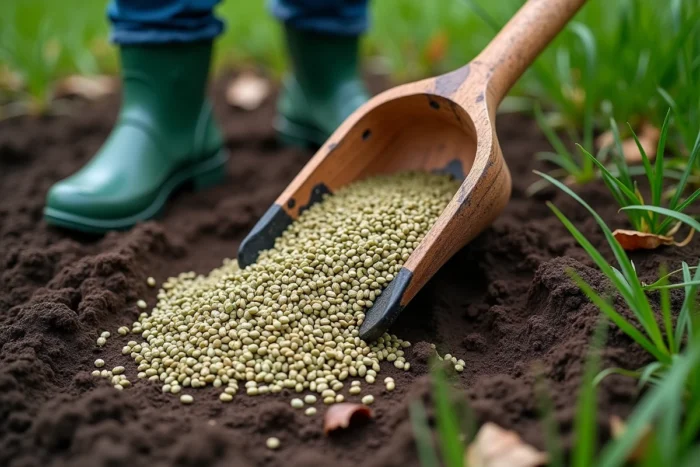
- Sow the seeds by broadcasting, crossing the passes to achieve an even distribution across the entire surface.
- Roll the lawn after sowing. This action presses the seeds against the moist soil and promotes even germination.
A well-prepared soil compensates for sowing done at the edge of the ideal window. Conversely, poorly leveled or compacted ground will yield disappointing results even at the best time.
Maintenance in the First Weeks After Lawn Sowing
The seeds are in the ground, the roller has been passed. The temptation is strong to let nature take its course. It is precisely at this stage that many sowings fail.
The soil must remain moist on the surface without being waterlogged throughout the germination phase, which typically lasts one to three weeks depending on the temperature. Light and frequent watering (morning and late afternoon) is better than a heavy watering that creates puddles and displaces the seeds.
Wait until the blades reach a sufficient height before the first mowing. Set the mower blade to a high position to avoid tearing out the still fragile young plants. Avoid walking on freshly sown areas until the grass has been mowed at least twice.
The choice of sowing time gives a head start, but it is the consistency of maintenance in the first weeks that transforms seeds into a dense lawn. A well-followed autumn sowing produces visible results by the following spring, with grass ready to withstand garden use.