
Investing in new real estate refers to the acquisition of a recently built or under-construction property, often within the framework of a sale in future state of completion (VEFA). In 2024, this market segment is undergoing a profound transformation: reservations for new homes by individuals have been declining quarter after quarter since the end of 2022, and the trend remains negative in the second quarter of 2024. Understanding the mechanisms behind this turnaround allows for the establishment of a profitable project despite a less favorable context.
Construction Costs and RE2020 Standards: What Affects the Price of New Properties
The price of a new home does not solely depend on the land. The environmental standard RE2020, which came into effect for building permits submitted since 2022, imposes thermal and low-carbon requirements that increase construction costs. Bio-sourced materials, enhanced insulation, efficient ventilation systems: each technical aspect contributes to raising the final cost.
Additionally, the rise in the price of materials and labor observed since the health crisis adds to this. New properties are structurally more expensive than they were three years ago, and this inflation is not temporary. For an investor, this means that the margin between the purchase price and the rental income decreases if the location is not rigorously selected.
Programs available in well-serviced medium-sized cities, where land remains affordable, offer a better balance between price per square meter and rental demand. The listings referenced on immobilierneuf1clic1toit.fr allow for comparing new programs by location and type, a useful filter for identifying markets where the price/rent ratio remains coherent.

End of the Pinel Scheme: Tax Alternatives for Investing in New Properties in 2025
The Pinel scheme will definitively end on December 31, 2024. Starting in 2025, no equivalent tax exemption mechanism will take over for new rental housing. This “tax gap” changes the game for investors who were counting on the tax reduction to enhance the profitability of their operation.
Two avenues deserve to be explored for projects signed in 2024 or launched in 2025:
- The status of non-professional furnished rental (LMNP) remains accessible and allows for the accounting depreciation of the property, thereby reducing the taxable income generated by rents. This regime applies to both new and old properties.
- The Loc’Avantages scheme (formerly Affordable Rental) offers a tax reduction in exchange for capped rents and an agreement with the National Housing Agency. It mainly concerns landlords willing to rent below market rates.
- The zero-interest loan (PTZ), recently expanded, can support a first-time buyer on a primary residence purchase in new properties, even if it does not directly concern pure rental investment.
The choice between these solutions depends on the investor’s tax profile and the type of rental considered (unfurnished or furnished). An investment in new properties in 2025 without tax leverage must show a sufficient gross rental yield to absorb the charges, which brings the question back to the purchase price and the local market rent level.
Rental Yield in New Properties: Variables to Master Before Buying
The gross yield of a rental investment is calculated by dividing the annual rent by the acquisition price, including fees. In new properties, reduced notary fees (around two to three percent compared to seven to eight in old properties) constitute a real advantage on the total cost of the operation.
The temporary exemption from property tax, granted for two years on new constructions in most municipalities, also improves cash flow in the early years. However, these advantages do not compensate for an overvalued purchase price.
Three Criteria That Determine Real Profitability
The rental tension in the neighborhood remains the primary factor. A new home located in an area where rental demand exceeds supply rents quickly and limits vacancy, the main enemy of yield.
The level of condominium charges in a new program is generally low in the first few years, but its evolution must be anticipated. Collective facilities (elevator, underground parking, green spaces) generate recurring costs.
The amount of the loan monthly payment, directly linked to the interest rate obtained, determines the monthly cash flow. In 2024, rates remain significantly higher than in 2021. Negotiating financing on duration and rate, or using a broker, can shift a project from deficit to balance.
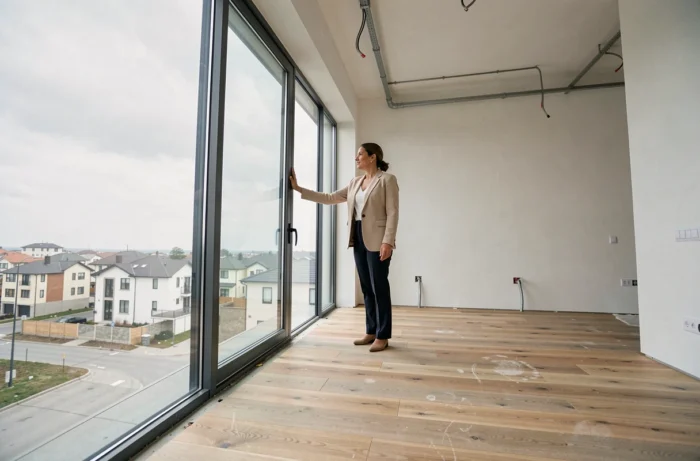
Location and Heritage: Choosing a New Home That Retains Its Value
Real estate investment is not only measured by the rent received. The potential capital gain upon resale constitutes the other component of overall long-term yield. In new properties, the quality of the location takes precedence over the quality of the finishes.
Cities that combine population growth, infrastructure projects (tramway, TGV station, university campus), and insufficient housing supply present the most favorable profile. Conversely, some suburban municipalities where new programs are multiplying without proportional rental demand expose the investor to property depreciation.
Purchasing a new property commits for several decades. A property compliant with RE2020 has the advantage of not requiring energy renovation work in the medium term, unlike an old property whose energy performance diagnosis (DPE) could prohibit rental in the coming years. This structural argument weighs in the establishment of a sustainable and rentable real estate heritage without additional costs.
The new housing market is undergoing an adjustment phase. Prices remain high, tax incentives are becoming scarce, and rental profitability requires finer selection than before. For an investor willing to refocus their analysis on the location-price pair rather than on tax exemption, new properties still have tangible advantages: reduced fees, guaranteed energy performance, and no anticipated work. The filter has simply changed.